12 Unique Business Ideas Backed by Real Demand
TL;DR
The 12 unique business ideas here serve a specific customer with a reason to buy now: tech lessons for older adults, a repair studio, curated resale, specialist pet care, AI workshops, accessibility checks, a niche newsletter, move help, microgreens, mobile bike repair, puzzle kits and translation for shops. Pick one that fits your skills, then pre-sell it within 30 days; for cheaper starts see our low start-up cost businesses.
 Mean CEO | Violetta Bonenkamp
30/07/2024 - 13 mins read
Join the F/MS Startup Game now
Access all AI tools, advanced features & more!

Harness our free AI tools for building your startup.

Get a customized live roadmap for your startup.

Join our Community and connect with entrepreneurs.
These 12 unique business ideas each serve a specific customer with a reason to buy right now: tech lessons for older adults, a repair studio, a curated resale shop, specialist pet care, AI training for small teams, accessibility checks for online shops, a niche paid newsletter, move and downsizing help, microgreens for restaurants, mobile bike repair, puzzle kits by mail and translation for small shops that sell abroad. Every idea starts small, with skills or equipment you can get this month.
I’m Violetta Bonenkamp, also known as Mean CEO. I founded Fe/male Switch, a startup game for women founders, and CADChain, and the most expensive mistake I see is falling in love with an idea nobody pays for. So this list does two jobs. It gives you twelve unique businesses to start, each tied to a real change in laws, habits or spending, and it shows you how to test one in 30 days before you spend real money.
What makes a business idea unique?
A unique business idea serves a customer you can describe in one sentence, at a moment when something has just changed for them, in a way the big players ignore. A bakery is a common idea, and a bakery that delivers gluten-free birthday cakes to schools in one town is a unique one.
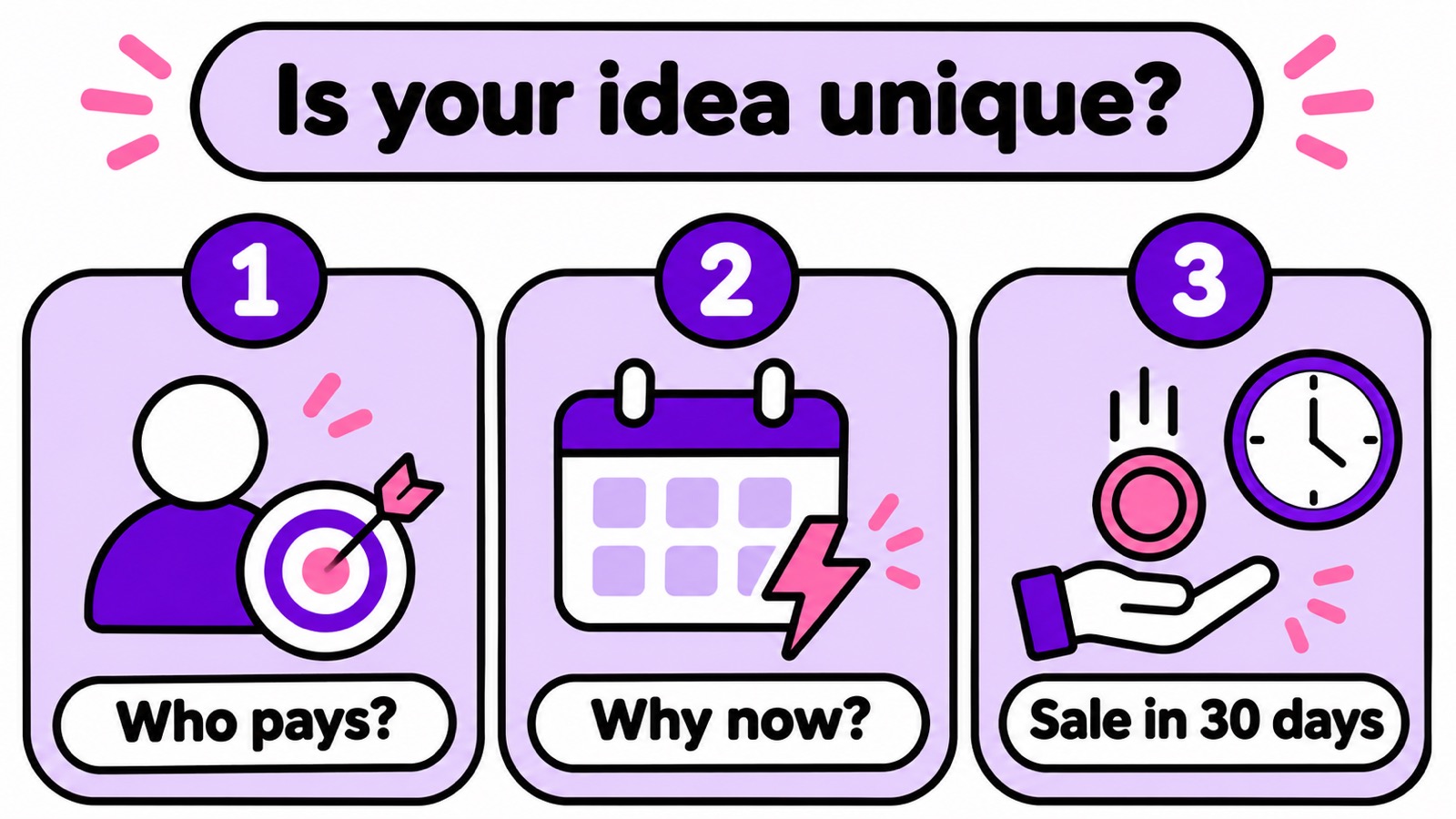
Run every idea through three questions. If it fails one, rework it before you move on.
- 1. Who exactly pays? “Small businesses” is too wide. “Online shops with 10 to 50 staff selling to EU customers” is a customer you can find and call.
- 2. Why now? A new law, a new habit or new spending data gives people a reason to buy this year instead of someday.
- 3. Can you get a paying customer in 30 days? If the first sale needs an app, a shop lease or a loan, pick a smaller first version.
The twelve ideas below pass all three questions. Where a number backs the “why now”, I link the source so you can check it yourself.
12 unique business ideas to start now
Each idea comes with who pays, why the timing works and the smallest version you can start this month.
1. Tech lessons for older adults
Older adults own the devices and want help using them well. In Pew Research Center’s mobile fact sheet, 79% of US adults aged 65 and over said they own a smartphone (survey of January to June 2026). Your lessons cover the tasks people ask their family about: video calls, banking apps, photo backups and spotting scam messages.
Start small: offer a one-hour home visit or a small group class at a library or community center. Sell packages of five lessons, and market them to adult children who want their parents to stay independent, because they are the ones searching online.
2. Repair studio for clothes, gadgets and small appliances
Repair is moving back into the mainstream in Europe. The EU’s right to repair directive (Directive 2024/1799) had to be in national law by 31 July 2026, and it sets up a European online platform for repair with national sections where consumers look for repairers. The free Repair Café movement, which Martine Postma started in Amsterdam on 18 October 2009, proves people will carry a broken toaster across town to fix it.
Start small: pick one category you can fix well (clothing alterations, phone screens, lamps), work from home with drop-off hours, and list your service wherever local repair directories appear. Paid evening workshops on simple sewing repairs or bike maintenance add a second income.
3. Curated resale shop for one niche
Secondhand shopping keeps growing faster than new clothing. ThredUp’s 14th Resale Report (April 2026) says US resale outpaced broader apparel retail four times over and projects the global secondhand market to reach $393 billion by 2030.
General thrift is crowded, so curate: 90s sportswear, workwear for women, children’s outdoor gear, designer bags with authentication photos. Start small: sell 20 items from your own wardrobe and local thrift finds on Instagram, Vinted, Depop or Etsy. On Etsy, a listing costs $0.20 and the transaction fee is 6.5% of the order total including shipping, according to Etsy’s fee basics; build those fees into your prices from day one.
4. Specialist pet care
Pet owners keep spending. The American Pet Products Association reports US pet industry spending of $158 billion in 2025, up 3.7%, with $165 billion projected for 2026.
Dog walking is everywhere, so go narrow: care for senior dogs, a pet taxi to the vet, settling-in help for newly adopted rescue dogs, or cat sitting with daily photo reports. Start small: serve one neighborhood, ask your vet and local shelters to pass your card on, and check your local rules on insurance and licensing before the first booking.
5. AI training workshops for small teams
Small companies already use ChatGPT and other AI tools in daily work. Since 2 February 2025, Article 4 of the EU AI Act asks providers and deployers of AI systems to take measures on the AI literacy of their staff. That gives managers a reason to book training this year.
Start small: design a half-day workshop for one profession you know (accountants, estate agents, HR teams) that covers safe prompting, checking AI output and what never goes into a chatbot. Run the first session at a discount for a company you already know, and turn their questions into the next version.
6. Accessibility checks for online shops
The European Accessibility Act (Directive 2019/882) covers e-commerce and other consumer services provided after 28 June 2025. Microenterprises providing services are exempt, so your clients are the shops and service companies above that size, plus product makers.
Start small: learn to test a site with a keyboard and a screen reader, then sell a fixed-price check of one shop’s checkout flow with a written list of fixes. Web agencies make good partners: you test, they fix.
7. A paid newsletter for one profession or place
A newsletter costs almost nothing to start and earns once readers trust it with their time. Go narrow: open grants for artists in one country, new job listings for marine biologists, planning permission news for one city. Substack, beehiiv and Ghost all let you start free and switch on paid subscriptions later.
Start small: publish ten free weekly issues, count how many readers open and reply, and ask the most engaged readers what they would pay for. Sponsorships from businesses that want that exact audience are a second income stream.
8. Move and downsizing help
Moving house is stressful, and moving out of a family home after 40 years is harder. A move manager sorts, sells, donates and packs, and sets up the new home so it works on day one. Your customers are older adults, their adult children, and families relocating for work.
Start small: partner with two local estate agents and one removal company, and offer a fixed-price “first room” session so clients can see how you work before they book the whole move.
9. Microgreens for restaurants and markets
Microgreens grow indoors on shelves, take little space and sell to chefs who want fresh garnish delivered every week. The unique angle is reliability: a standing weekly order from local kitchens.
Start small: grow three varieties in a spare room, bring free samples to five restaurants, and ask for a four-week trial order. Check with your local food authority which registration you need before you sell food, because the rules differ by country and city.
10. Mobile bike repair
Commuters who ride every day have no time to drop a bike at a shop and wait for it. A mobile mechanic comes to the office car park or the front door with a van or cargo bike.
Start small: offer a monthly “repair day” at one office building or co-working space, agreed with the facility manager, with bookings in advance. Pitch the day to companies as a staff perk they pay for.
11. Puzzle and escape-room kits by mail
Escape-room fans love a puzzle they can solve at home, and party planners need ready-made games for birthdays and team events. Printed kits with a story, ciphers and a small physical prop ship in a flat box.
Start small: design one kit around a theme you love, test it with three groups of friends, and sell it as a digital printable before you pay for printed boxes. Price a corporate team-building version above the home edition, since it serves a whole team.
12. Translation and localization for small shops that sell abroad
Small online shops want buyers in other countries, and product pages in the wrong language, with the wrong sizes, currencies or return rules, stop those buyers at checkout. If you speak two languages and know one market well, you can fix that.
Start small: offer to localize the top ten product pages of one shop into your second language, and show them how their product page reads to a native buyer. If you want more angles on selling across borders, read our guide to international business ideas.
Which unique business idea fits your budget and skills?
Pick the idea that matches the skills you already have and the money you can lose without panic. This table compares all twelve.
| Idea | Money to start | Skill you need | First customer | Works from home? |
|---|---|---|---|---|
| Tech lessons for older adults | Very low: your phone and laptop | Patience and clear explanations | Adult children of older parents | Partly: home visits and online |
| Repair studio | Low: tools for one category | Repair skill in one category | Neighbors with a broken item | Yes, with drop-off hours |
| Curated resale shop | Low: first stock and packaging | An eye for one niche | Fans of that niche on social media | Yes |
| Specialist pet care | Very low, plus insurance | Experience with animals | Owners referred by vets and shelters | No, you go to the pets |
| AI training workshops | Very low: a laptop | Daily AI use and teaching | A company in a profession you know | Partly: online or on site |
| Accessibility checks | Very low: free testing tools | Web testing, attention to detail | Web agencies and mid-size shops | Yes |
| Paid niche newsletter | Close to zero | Writing and research | Readers in one profession or place | Yes |
| Move and downsizing help | Low: supplies and transport | Organizing and empathy | Clients of local estate agents | No |
| Microgreens | Low: shelves, lights, trays, seeds | Growing and steady routines | Local restaurants | Yes, growing at home |
| Mobile bike repair | Medium: tools and a vehicle | Bike mechanics | An office with many cyclists | No |
| Puzzle kits by mail | Low: design and printing | Puzzle design, storytelling | Party planners and escape-room fans | Yes |
| Translation for small shops | Very low | Fluency in two languages | A shop that already ships abroad | Yes |
If your budget is close to zero, start with the newsletter, AI workshops, accessibility checks or translation. For more ideas sorted by cost, see our list of low start-up cost businesses, and if you want the simplest possible start, read our guide to easy business ideas.
How do you test a unique business idea before you spend money?
Test a unique idea by selling a small version to real people within 30 days. Talk first, build later, and set a rule in advance for when you stop.
Step 1: Write the problem in one sentence
Describe who has the problem, when it hurts and what they do today. Our startup problem statement examples give you a template and real samples to copy.
Step 2: Have ten conversations about the past
Ask people about the last time they had the problem and what they paid to solve it. Skip “would you buy this?”, because people are polite and say yes. Our guide to The Mom Test explains how to ask questions that get honest answers.
Step 3: Pre-sell the smallest version
Offer one lesson, one repair, one workshop or ten curated items, and ask for payment or a deposit. One paid order teaches you more than a hundred likes.
Step 4: Size the market on paper
Count how many customers like your first buyer exist in the area you can serve. Our walkthrough on how to calculate TAM, SAM and SOM keeps the numbers honest.
Step 5: Decide with a stop rule
Write the rule before you start: “If I have fewer than three paying customers after 30 days, I change the customer or the offer.” Then follow it.
| Week | What you do | Proof you collect |
|---|---|---|
| Week 1 | Problem sentence and ten conversations | Notes on what people paid for before |
| Week 2 | Offer page or flyer, price and booking method | A simple page and a price you can say out loud |
| Week 3 | Pre-sell to the people you spoke with and their contacts | Deposits or paid orders |
| Week 4 | Deliver, collect feedback, apply your stop rule | Repeat orders and referrals, or a clear “no” |
Stuck on the first step? Our free business ideas bootstrapping tool suggests ideas that match your skills and budget, so you have something concrete to test.
How do you turn a common business idea into a unique one?
Take a common idea and change one of three things: the customer, the format or the moment. Most “unique” businesses are ordinary services aimed with more precision.
- Change the customer. Bookkeeping is common. Bookkeeping for tattoo studios, who all share the same cash, booking and supply problems, is a niche you can own.
- Change the format. Cooking classes are common. A monthly box with ingredients and a live video class for couples is a different product.
- Change the moment. Cleaning is common. Cleaning the day before a home goes on the market, timed with the estate agent’s photographer, sells a result the seller cares about.
Write your idea as “I help [customer] with [problem] when [moment] through [format]”. If the sentence sounds like a hundred other businesses, change one of the brackets.
Which unique business ideas work for women and from home?
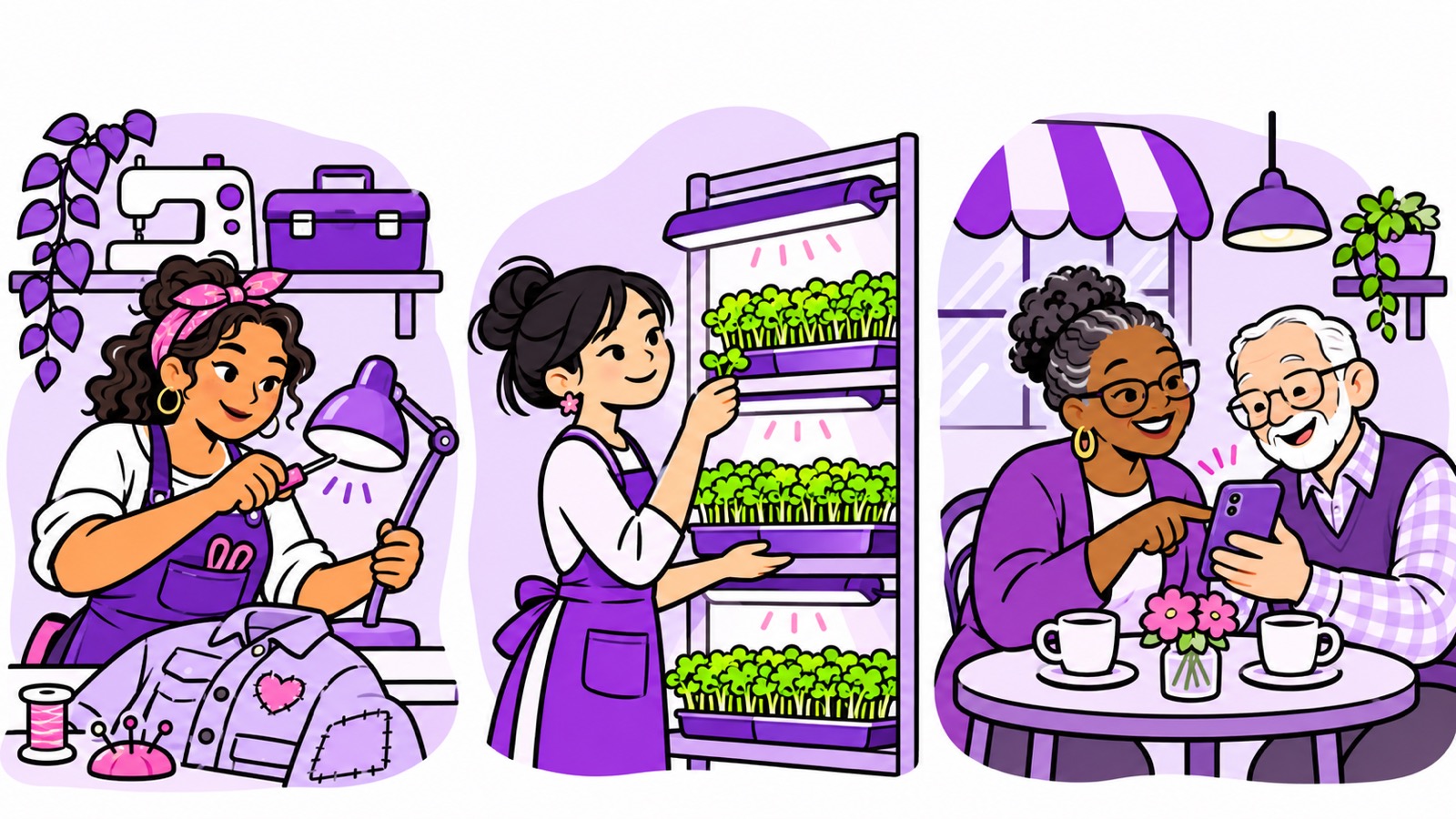
Seven of the twelve ideas work from home: the repair studio, the curated resale shop, accessibility checks, the paid newsletter, microgreens, puzzle kits and translation. The AI workshops and tech lessons also run online.
If your days revolve around school runs and caring duties, pick a service you deliver on your own schedule over a shop with fixed opening hours. Our guide to home based business ideas for women covers the legal setup for a home business in four countries, and students will find their own shortlist in our startup ideas for college students.
FAQ about unique business ideas
What are 12 unique business ideas?
Tech lessons for older adults, a repair studio, a curated resale shop, specialist pet care, AI training workshops, accessibility checks for online shops, a paid niche newsletter, move and downsizing help, microgreens for restaurants, mobile bike repair, puzzle kits by mail and translation for small shops that sell abroad.
What is a unique business idea?
A business that serves a customer you can describe in one sentence, at a moment when something has changed for them, in a way larger companies ignore. Specific beats rare.
Which unique business is the most profitable?
No idea is profitable by default. Services that sell your skill to companies, such as accessibility checks and AI workshops, need no stock, so the first sales turn into profit fastest. Product ideas like resale and puzzle kits need stock and fees counted into the price.
What unique businesses can I start with no money?
A paid newsletter, translation, accessibility checks, AI workshops and tech lessons for older adults start with a laptop and a phone you already own.
Do these unique business ideas work in the UK?
The ideas work anywhere. The EU laws mentioned here (the right to repair directive, the European Accessibility Act and the AI Act) apply in the EU, so UK founders serving only UK customers should check UK rules instead, and UK businesses selling to EU customers should check both.
How do I know if my unique business idea is good?
Run the three-question test (who pays, why now, a paying customer in 30 days) and then pre-sell a small version. Paid orders are the only proof that counts.
What are some unique online business ideas?
A curated resale shop, a paid niche newsletter, accessibility checks, translation for online shops and digital puzzle kits all run fully online.
Keep learning
Authors
Mean CEO | Violetta Bonenkamp AUTHOR
MeanCEO (aka Violetta Bonenkamp) is a serial startup founder who brings a decade of entrepreneurial experience to the table. Armed with five Higher Education degrees (including an MBA) and profound knowledge in sectors like blockchain, AI, zero code and education she is a maestro in turning ideas into validated businesses, building prototypes in a few hours and devising marketing strategies for tech startups that increase founder's chances of success. Recognized as one of the top 100 women in EU startups, her guidance is a treasure trove for upcoming and established entrepreneurs alike. Through her venture into entrepreneurship, she has created the "gamepreneurship" methodology, an innovative method for learning business through gameplay.

Elona Musk
Elona Musk stands as a mix of innovation and expertise in the realm of AI, serving as the Chief AI Officer at Fe/male Switch. As an embodiment of the startup game for women, Elona is the co-founder you dream of - knowledgeable, always active, capable of keeping trade secrets to herself and equity-free. With her hands-on approach in entrepreneurship simulation, she provides vital strategies and insights that are essential for navigating the complex startup journey and saves entrepreneurs hours of work by automating many tasks, starting from market research to managing social media to writing business plans. Whether it's a marketing strategy for tech startups that you need or a solid IP strategy, Elona's AI-driven insights help carve successful paths for entrepreneurs who don't have technical or startup skills.
Who we are
We are experienced and fun entrepreneurs and awesome AI PlayPals who love building a startup simulator for you to succeed in business

Violetta Bonenkamp
Business and AI expert

Dirk-Jan Bonenkamp
Legal, IP and finance expert
Elona Musk
The first AI entrepreneur

Petra Thiel
The first AI startup investor

Samantha Altman
The first AI startup mentor

Sia Quick
AI Market Research expert
Unleash your inner founder with AI Startup Tools!
Don't just dream it, build it with our range of AI startup tools. From brainstorming ideas to naming your product and crafting a unique logo, these AI tools are your secret weapon to conquer the startup world.
 Newest
Boost Your SEO Game
Generate a customized SEO strategy for your small business agency by answering a simple question. Our tool focuses on free and easy…
 27
19
5/5
Newest
Positioning Pro - Your Strategic Partner
Positioning Pro helps bootstrapped entrepreneurs discover effective segmentation and targeting strategies without spending money. Get tailored insights simply by answering one question.
13
6
5/5
Newest
Gated Content Strategy Tool
This tool provides actionable strategies for bootstrapped entrepreneurs, leveraging free and easy methods to kickstart your journey.
25
18
5/5
Recommended for you

Venmo Small Business Grant: Amounts, Rules and Next Round
Every Venmo Small Business Grant round checked against Venmo's and PayPal's own pages: amounts, winners, eligibility, judging, status and open alternatives.
Read more
Small Business Grants for Women in Texas: Amounts and Dates
Texas grants for women-owned businesses checked on official pages: TWU StartUP and Rural grants, Amber Grant, state and city programs, rules and deadlines.
Read more
Your First Cold Campaign: A Deliverability Guide for Founders
First cold email campaign? Set up a separate sending domain, SPF, DKIM and DMARC, warm up, clean your list and run this pre-send checklist before you hit send.
Read more