Example of a Marketing Plan: Sample, Sections and Real Plans
TL;DR
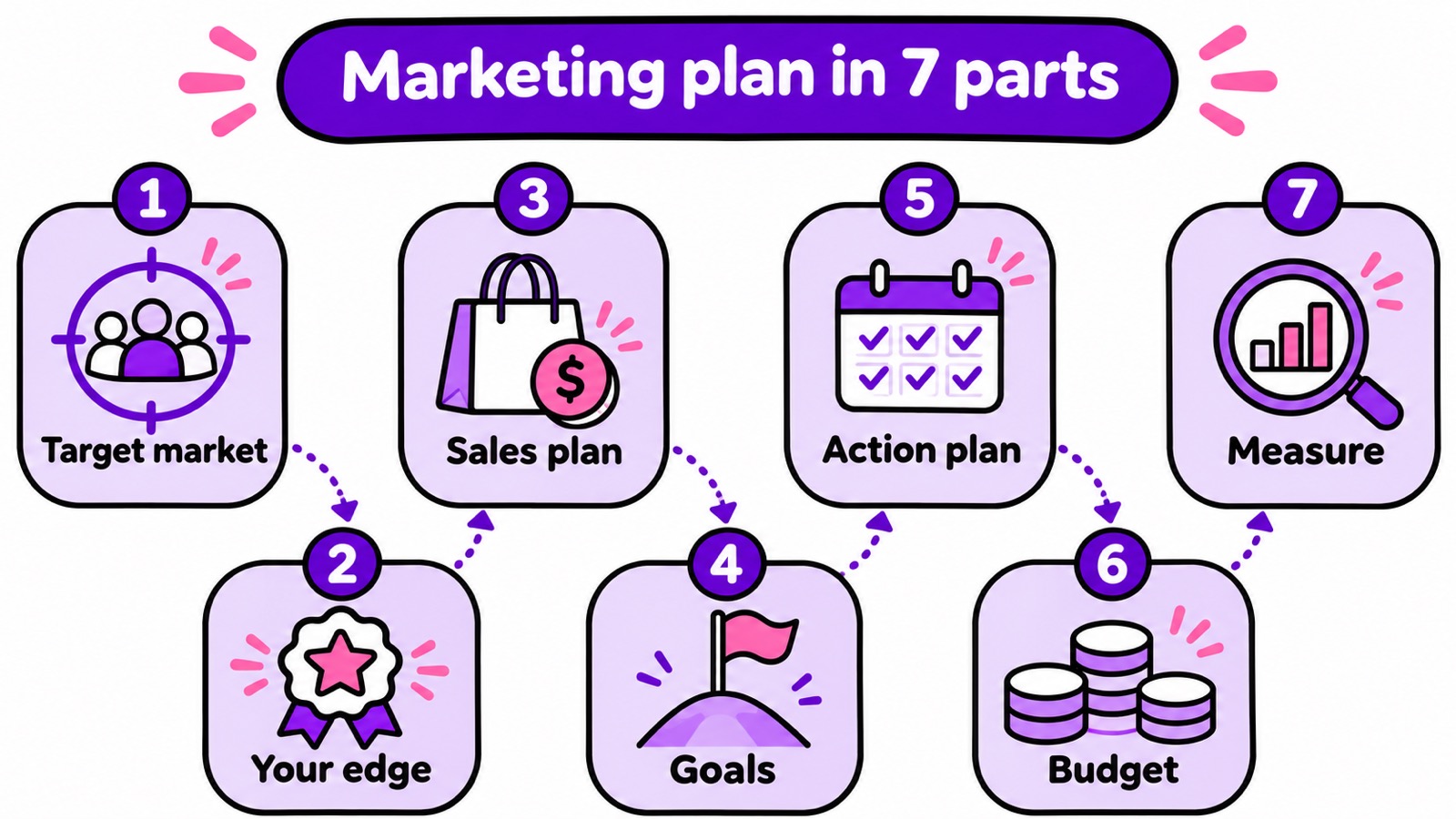
A good example of a marketing plan fills in seven parts on one page: target market, competitive advantage, sales plan, goals for the next year, action plan, budget and a date to measure results. Start with the sample below, then compare it with the main types of marketing strategies to pick your channels.
 Mean CEO | Violetta Bonenkamp
01/08/2024 - 14 mins read
Join the F/MS Startup Game now
Access all AI tools, advanced features & more!

Harness our free AI tools for building your startup.

Get a customized live roadmap for your startup.

Join our Community and connect with entrepreneurs.
An example of a marketing plan is only useful when you can see every section filled in: who you sell to, why they pick you, how the sale happens, what you want to reach in the next 12 months, which channels you pay for, what it all costs and how you will check that it worked. This guide gives you exactly that, with a complete sample plan for a small startup and three real plans you can open and study.
I’m Violetta Bonenkamp, also known as Mean CEO, founder of Fe/male Switch, a startup game for women founders. Most first marketing plans I see are a list of channels with no goal, no budget and no date to check results. Below you get the structure the U.S. Small Business Administration recommends, a filled-in sample, a brand plan from a real destination marketing organization, and the version you need inside a business plan.
If you would rather hear it than read it, our podcast episode on building a start up marketing plan walks first-time founders through a plan that needs no tech skills.
What is a marketing plan, and how is it different from a marketing strategy?
A marketing plan is the written list of actions you will take to persuade people to buy, with goals, channels, a budget and a date to measure. The SBA puts it simply: your business plan holds the central elements of your marketing strategy, and your marketing plan turns that strategy into action.
So the strategy is the big decision (who you serve and why they choose you), and the plan is the calendar, the money and the checklist. A campaign plan is smaller again. HubSpot’s marketing plan guide describes the marketing plan as the high-level view of your strategies and a campaign template as a focused plan for one push, such as a seasonal sale.
| Document | What it answers | Time span | Length |
|---|---|---|---|
| Marketing strategy (inside the business plan) | Who are our customers, why do they pick us, how does a sale happen? | Several years | A few paragraphs to a few pages |
| Marketing plan | What will we do, on which channels, for how much money, and how will we measure it? | 12 months, reviewed at least once a year | One page for a new startup, more as you grow |
| Campaign plan | What exactly happens in this one launch, sale or event? | Days or weeks | One to two pages |
Before you plan any tactics, decide which kind of marketing fits your business. Our overview of the main types of marketing strategies helps you pick one before you fill in the plan below.
What sections does a good marketing plan include?
Seven sections cover almost every small business. The SBA lists them on its marketing and sales page and adds a sensible rule: use what works for your business and skip what doesn’t.
| Section | What goes in it | Question to answer in one sentence |
|---|---|---|
| 1. Target market | Size, demographics, habits and trends behind demand | Who buys, and how many of them can we reach? |
| 2. Competitive advantage | Better product, lower price, better service, a certification | Why would they pick us over the alternative? |
| 3. Sales plan | Retail, wholesale, your own online shop, each step after the decision to buy | How does money actually reach us? |
| 4. Marketing and sales goals | Goals for the next year, such as email subscribers or sales growth | What number do we want, by when? |
| 5. Marketing action plan | Channels, pricing, special offers, support after the sale | What do we do each month? |
| 6. Budget | A full breakdown of what the plan costs | How much, and where does each euro go? |
| 7. Measure and update | Compare marketing and sales costs with the revenue they bring | Did it pay back, and what do we change? |
One warning from the SBA page is worth repeating: some products have federal rules on advertising and labeling, so check that your claims are legally allowed before you pay for a single ad.
A marketing plan example for a small startup
Here is a filled-in sample. Studio Patch is a fictional company and every number in this section is illustrative, picked to show the format. Swap in your own research before you use any of it.
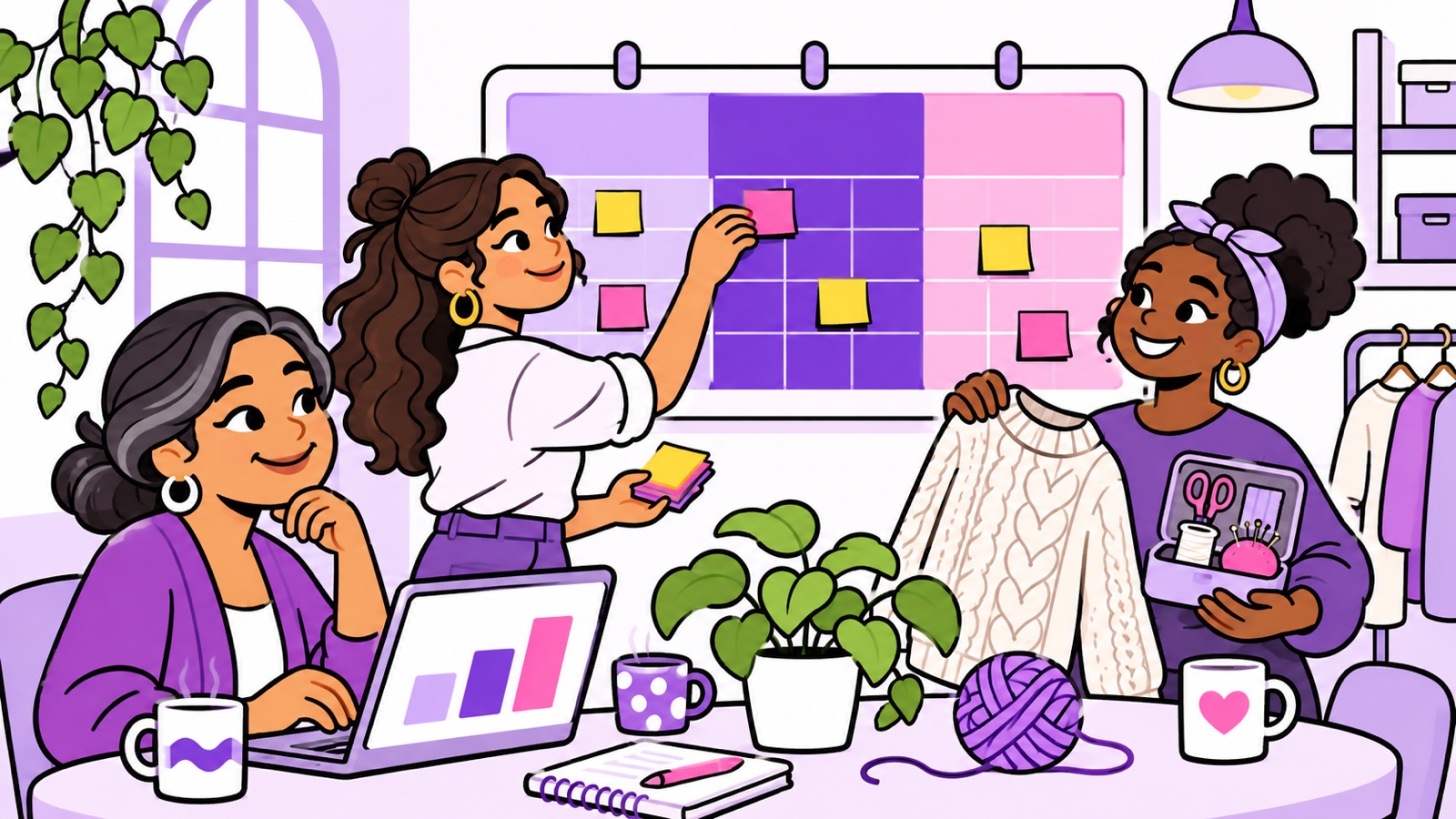
Studio Patch sells knitwear repair kits online, plus a monthly video class on visible mending. One founder, part-time, launching in spring.
1. Target audience example
Women aged 25 to 45 in the Netherlands and Germany who buy good wool sweaters, care about clothing waste and already watch knitting and mending videos. They find ideas on Instagram and YouTube, and they buy from small shops when the story is clear. A good target audience example names the person, the habit and the place you reach them, so anyone on your team can picture one real buyer.
2. Competitive advantage
Every kit comes with a video class in English, Dutch and German, so a complete beginner can repair a sweater in one evening. Generic sewing kits in supermarkets have no instructions.
3. Sales plan
Sales happen in the Studio Patch online shop. The buyer sees a short video, picks a kit by color, pays by card or iDEAL, and receives a welcome email with the class link the same day. Two local yarn shops sell the kits on consignment.
4. Goals for the next 12 months
- Sell 600 kits by the end of month 12 (illustrative).
- Reach 2,000 email subscribers by month 9.
- Get 80 class subscribers paying monthly by month 12.
Each goal follows the SMART format (specific, measurable, achievable, relevant, time-bound). HubSpot’s guide turns a vague wish about more followers into a SMART goal you can check: “increase my Facebook following by 30% by June.”
5. and 6. Action plan and budget
| Channel | Action | When | Budget (illustrative) | What we measure |
|---|---|---|---|---|
| Instagram and YouTube | Two before-and-after repair videos a week | Every month | €0 plus 4 hours a week | Profile visits to shop visits |
| Free mini-class in exchange for an email, monthly newsletter | From launch | €15 a month for the email tool | Subscribers, newsletter to sale rate | |
| Partnerships | Kits on consignment in two yarn shops, one live workshop each | Months 2 and 6 | €300 for stock and travel | Kits sold per shop |
| Paid ads | Small test on the best organic video | Months 4 to 6 | €600 in total | Cost per sale against margin per kit |
| Press and podcasts | Pitch five knitting and slow fashion podcasts | Month 3 | €0 | Episodes booked, traffic from show notes |
7. Measure and update
On the first Monday of every quarter, Studio Patch compares what each channel cost with the revenue it brought. Any channel that costs more than it earns for two quarters in a row gets cut, and the money moves to the best performer.
That is a complete plan on one page. Our podcast episode with another startup marketing plan example shows how a founder with an even smaller budget picks just one or two channels.
Which real marketing plan examples are worth studying?
The best marketing plans to learn from are the ones you can read in full. Most companies keep theirs private, so these three public examples are worth your time.
| Example | Who made it | What to copy |
|---|---|---|
| John and Kelly’s auto repair shop | U.S. Small Business Administration | A short local plan: one target market, one advantage, paid ads, a review date |
| FY26 Business and Marketing Plan | Visit SLO CAL, San Luis Obispo County, California | Yearly objectives with dated results, research, multi-year brand building |
| Marketing plan templates | HubSpot | Fill-in-the-blank sections, buyer personas, SMART goals |
The SBA small business example
The SBA’s own example follows John and Kelly, who open an auto repair shop. Their target market is anyone with a car, and they set themselves apart from other local garages with service and affordable prices. They aim for a set number of new customers each month, buy ad space on two local TV news websites, the local newspaper’s site and a local radio station, and set a date to compare the ad costs with the revenue those ads brought in. It is a tiny plan, and every part of it is checkable.
The Visit SLO CAL business and marketing plan
The FY26 Business and Marketing Plan of Visit SLO CAL, the tourism organization of San Luis Obispo County, is 88 pages long and public. Four things in it are worth stealing for a startup:
- Four objectives at the top, such as “amplify and steward the SLO CAL brand through unified efforts”, with strategies and results under each one.
- Results with deadlines, such as finalizing standard operating procedures by November 30, 2025 and running a visitor profile study by October 31, 2025.
- A research section on media trends and travel trends, followed by what each trend means for the plan.
- Proof of results: brand tracking research that compares people who saw the ads with people who didn’t.
To compare your plan with what established companies do, see the 10 best marketing strategies companies use in 2026, and pick a ready template from our list of marketing strategy PDFs and templates.
How do you write the marketing section of a business plan?
In a business plan, the marketing and sales section explains how you will attract and keep customers and how a sale actually happens. The SBA’s business plan guide adds a detail many founders miss: you will use this section later for your financial projections, so describe it fully.
The length depends on the plan type. The SBA describes traditional business plans as detailed documents that can run to dozens of pages and that lenders and investors commonly request, while a lean startup plan fits on one page and can take as little as one hour.
| Plan type | Marketing section | Best for |
|---|---|---|
| Lean startup plan | Three lines: customer segments, channels, and why customers pick you | Testing an idea, talking to mentors, your own focus |
| Traditional plan | Target market, competition, pricing, channels, sales process, budget, all tied to the revenue forecast | Bank loans, investors, grant applications |
Business plan marketing strategy example
Here is how Studio Patch (still fictional) would write it in a traditional plan:
“Studio Patch sells knitwear repair kits with a video class to women aged 25 to 45 in the Netherlands and Germany who own quality wool clothing. We reach them through our own repair videos on Instagram and YouTube, an email list built with a free mini-class, and two partner yarn shops. Customers buy in our online shop and receive the class link by email on the day of purchase. Our first-year marketing budget is €1,100 plus the founder’s time, and we review each channel’s cost against its revenue every quarter.”
Notice how each sentence answers one of the seven sections. A plan reader, whether a bank or an investor, wants to trace a line from the customer to the revenue numbers on a later page. The size of your market belongs here too, and our guide on how to calculate TAM, SAM and SOM shows how to put a defensible number on it.
What does a brand marketing plan example look like?
A brand marketing plan sets a long goal for how people should see you, and then adds campaigns year after year toward it. Visit SLO CAL is a clear case. In 2021 the organization set what it calls a BHAG (Big Hairy Audacious Goal): to make SLO CAL as well-defined, well-known and well-loved as Southern California and Northern California.
Every yearly plan since then builds on that one goal. Their FY26 plan shows a hero campaign, “The Land of…”, launched in the first year, with new layers added each year, such as stories that connect the different towns of the county and a social media series made with travel creators. The plan also reports brand tracking research by Heart+Mind Strategies, whose 2023 online survey had 3,537 respondents.
For a startup, the lesson is simple: write one sentence about how you want to be known in three years, and make every campaign in this year’s plan earn a piece of it. Brand work also needs a visual system, and our guide to using Canva in a startup helps you keep posts, decks and ads looking like one brand.
Do you need a 1-year, 3-year or 5-year marketing plan?
Write your marketing plan for 12 months and keep a longer direction above it. The SBA says marketing plans should be maintained on an annual basis at the minimum, and that measuring your return on investment tells you which part to update.
Visit SLO CAL shows how the layers fit: a multi-year Strategic Direction 2026 acts as its “north star”, and the annual Business and Marketing Plan sets the year’s program of work. One of its FY26 results is to publish a new 4-year plan, Strategic Direction 2030.
| Horizon | What to write | Detail level |
|---|---|---|
| 1-year marketing plan | All seven sections, monthly actions, a budget per channel | Full detail, reviewed every quarter |
| 3-year marketing plan | Brand goal, target segments, which markets or products come next | One to two pages, reviewed every year |
| 5-year marketing plan | Where the brand should stand and which customers you serve then | A few sentences; for a young startup, anything more detailed is fiction |
How do you write a marketing plan for a new product?
A new product plan uses the same seven sections, with the action plan split into three phases: before, during and after launch. The goal of the first phase is a list of people who already said yes.
- Before launch: interview ten target customers, publish a waiting list page, share the build in public, line up two partners who will tell their audience.
- Launch week: email the waiting list first, publish your launch post and video, ask the first buyers for a short review.
- After launch: follow up with every buyer, collect questions for an FAQ, cut the channel that brought nobody.
Write down what your competitors already do on each channel before you pick yours. Our five steps for a useful startup competitor analysis give you a template for that page of the plan. If you want a first draft of channels to react to, try our AI marketing strategy tool for tech startups, then check every suggestion against your own budget and audience.
How is a marketing plan judged in a business competition?
Student and startup competitions reward the same thing as investors: a clear audience, a measurable goal and a realistic budget. DECA, a student organization for high school and college students in marketing and business, runs Integrated Marketing Campaign events where participants plan a campaign of no more than 45 days for a real event, product or service, and present it in a pitch deck limited to 20 slides, appendix included.
If you are preparing a business marketing plan for a competition, build it like the Studio Patch example, shrink the action plan to the campaign window, and give every channel a number the judges can check. Rules change each season, so read the current DECA Guide for your event before you start.
Which mistakes make a marketing plan useless?
Here is what I see most when founders show me their first plan:
- Everyone is the target. “Women entrepreneurs” covers millions of people, while “freelance designers in Lisbon who want their first employee” tells you where to find them this week.
- Channels without goals. Posting on four platforms with no number attached is a hobby.
- No budget line for time. A solo founder’s hours are the biggest cost in most early plans, so write them down.
- No review date. The SBA’s John and Kelly example has one. Yours needs one too.
- Copying a big brand. Visit SLO CAL spends years on brand building with a full team. A startup with three months of runway needs sales first.
FAQ about marketing plan examples
What is an example of a marketing plan?
A one-page document with seven parts: target market, competitive advantage, sales plan, goals for the next year, action plan with channels, budget, and a date to measure results. The Studio Patch sample above shows all seven filled in.
What is a simple marketing plan example for a small business?
The SBA’s auto repair shop: one target market (anyone with a car), one advantage (service and price), a goal for new customers each month, local online and radio ads, and a date to compare ad costs with revenue.
What are the best marketing plan examples to read?
Public ones you can read in full: the SBA’s small business example, the Visit SLO CAL FY26 Business and Marketing Plan, and HubSpot’s fill-in templates.
How long should a marketing plan be?
One page for a new startup or a lean business plan. Detailed plans for lenders and investors run longer, and Visit SLO CAL’s full public plan is 88 pages.
What is a target audience example in a business plan?
Name the person, the habit and the place you reach them: “women aged 25 to 45 in the Netherlands and Germany who buy wool sweaters and watch knitting videos on YouTube.”
When should I update my marketing plan?
Review results every quarter and rewrite the plan at least once a year, which matches the SBA’s advice to maintain marketing plans annually at the minimum.
Keep learning
Authors
Mean CEO | Violetta Bonenkamp AUTHOR
MeanCEO (aka Violetta Bonenkamp) is a serial startup founder who brings a decade of entrepreneurial experience to the table. Armed with five Higher Education degrees (including an MBA) and profound knowledge in sectors like blockchain, AI, zero code and education she is a maestro in turning ideas into validated businesses, building prototypes in a few hours and devising marketing strategies for tech startups that increase founder's chances of success. Recognized as one of the top 100 women in EU startups, her guidance is a treasure trove for upcoming and established entrepreneurs alike. Through her venture into entrepreneurship, she has created the "gamepreneurship" methodology, an innovative method for learning business through gameplay.

Elona Musk
Elona Musk stands as a mix of innovation and expertise in the realm of AI, serving as the Chief AI Officer at Fe/male Switch. As an embodiment of the startup game for women, Elona is the co-founder you dream of - knowledgeable, always active, capable of keeping trade secrets to herself and equity-free. With her hands-on approach in entrepreneurship simulation, she provides vital strategies and insights that are essential for navigating the complex startup journey and saves entrepreneurs hours of work by automating many tasks, starting from market research to managing social media to writing business plans. Whether it's a marketing strategy for tech startups that you need or a solid IP strategy, Elona's AI-driven insights help carve successful paths for entrepreneurs who don't have technical or startup skills.
Who we are
We are experienced and fun entrepreneurs and awesome AI PlayPals who love building a startup simulator for you to succeed in business

Violetta Bonenkamp
Business and AI expert

Dirk-Jan Bonenkamp
Legal, IP and finance expert
Elona Musk
The first AI entrepreneur

Petra Thiel
The first AI startup investor

Samantha Altman
The first AI startup mentor

Sia Quick
AI Market Research expert
Unleash your inner founder with AI Startup Tools!
Don't just dream it, build it with our range of AI startup tools. From brainstorming ideas to naming your product and crafting a unique logo, these AI tools are your secret weapon to conquer the startup world.
 Newest
Boost Your SEO Game
Generate a customized SEO strategy for your small business agency by answering a simple question. Our tool focuses on free and easy…
 27
19
5/5
Newest
Positioning Pro - Your Strategic Partner
Positioning Pro helps bootstrapped entrepreneurs discover effective segmentation and targeting strategies without spending money. Get tailored insights simply by answering one question.
13
6
5/5
Newest
Gated Content Strategy Tool
This tool provides actionable strategies for bootstrapped entrepreneurs, leveraging free and easy methods to kickstart your journey.
25
18
5/5
Recommended for you

Venmo Small Business Grant: Amounts, Rules and Next Round
Every Venmo Small Business Grant round checked against Venmo's and PayPal's own pages: amounts, winners, eligibility, judging, status and open alternatives.
Read more
Small Business Grants for Women in Texas: Amounts and Dates
Texas grants for women-owned businesses checked on official pages: TWU StartUP and Rural grants, Amber Grant, state and city programs, rules and deadlines.
Read more
Your First Cold Campaign: A Deliverability Guide for Founders
First cold email campaign? Set up a separate sending domain, SPF, DKIM and DMARC, warm up, clean your list and run this pre-send checklist before you hit send.
Read more