Startup Stories: 10 Founder Journeys and What to Copy
TL;DR
The most useful startup stories show the low moment and the decision after it: Airbnb's two-booking launch, Slack's failed game, Dropbox's demo video, Spanx's bathroom pitch, Canva's yearbooks, Bumble's campus cookies and Mailchimp's bootstrapped growth. Tell your own story in four beats (problem, first try, proof, lesson), and see how these companies won their first customers in our startup business examples.
 Mean CEO | Violetta Bonenkamp
29/06/2024 - 9 mins read
Join the F/MS Startup Game now
Access all AI tools, advanced features & more!

Harness our free AI tools for building your startup.

Get a customized live roadmap for your startup.

Join our Community and connect with entrepreneurs.
The best startup stories are the ones with a turning point you can copy: Airbnb launching with two bookings, Slack growing out of a failed game, Sara Blakely pitching Spanx in a department store bathroom. This guide retells 10 startup success stories through that low moment and the decision that followed, then shows you how to tell your own startup story in a pitch, on your About page or on LinkedIn.
I’m Violetta Bonenkamp, also known as Mean CEO. I founded Fe/male Switch, a startup game for women founders, and CADChain, and I have learned to distrust success stories that skip the ugly middle. The middle is where the lesson lives. So every story here comes with its source, the moment things looked bad and the one habit you can steal this week.
Which startup success stories are worth learning from?
Learn from stories where the founders had no unfair advantage at the start: no fashion contacts, no big budget, no finished product. These 10 successful startup stories all began that way.
| Startup | The low moment | The decision that changed the story |
|---|---|---|
| Airbnb | Two bookings at its SXSW launch in 2008 | Founders went door to door to help hosts |
| Slack | The team’s multiplayer game attempt ended | They turned their internal chat tool into the product |
| Dropbox | No product ready for the public | A demo video built the wait list |
| Mailchimp | A side project inside a web design agency | Grew on its own revenue, without venture capital |
| Duolingo | A business plan built on selling translations | Kept the product, changed the business model |
| Spanx | Cold calls with no retail contacts | A live demo in a Neiman Marcus bathroom |
| Canva | A big idea and no track record | Proved it first with school yearbooks |
| Bumble | A dating app with a modest budget | Launched campus by campus with cookies and pizza |
| Stitch Fix | No algorithm and no customers | Styled 20 friends by hand |
| Rent the Runway | A loved brand whose shares fell under $2 | A reminder that growth needs sound economics |
For the first-customer tactics behind these companies, with a table of 13 businesses side by side, read our startup business examples.
What can startup founder stories teach about first customers?
They teach that the first customers come from hard, manual work that nobody writes press releases about. Here are four founder stories where that work made the difference.
Airbnb: two bookings, then door to door
Airbnb says Airbed & Breakfast officially launched at SXSW in March 2008 with just two bookings (Airbnb newsroom). Later the founders went door to door in New York, recruiting new users and helping existing hosts improve their listings, as Paul Graham describes in Do Things That Don’t Scale.
Steal this: visit ten of your users this month and fix one thing for each of them yourself.
Dropbox: a video before a product
Drew Houston and Arash Ferdowsi didn’t wait for a finished product. A demo video on Digg, packed with jokes for Digg’s audience, brought 75,000 wait-list signups within 24 hours against the 15,000 the team expected (TechCrunch).
Steal this: record a two-minute screen video of the result your product delivers and post it where your users already hang out.
Stitch Fix: 20 friends and a lot of handwork
In 2010 Katrina Lake recruited 20 friends for an experiment, to see if she could pick clothes that matched each person’s style (NPR, How I Built This). By 2018 NPR described the company as having more than two million customers.
Steal this: do the job your software will do, by hand, for 20 people before you write code.
Bumble: cookies for a sorority
Bumble launched in December 2014 in Austin on a modest budget. Whitney Wolfe Herd paid a bakery $20 to put the Bumble logo on yellow cookies, took them to a sorority, then dropped off pizzas at fraternities (CNBC). Seven years after launch she became the youngest female founder to take a company public.
Steal this: if your product needs two groups, bring both into the same small place at the same time.
Which startup stories began with a failure or a pivot?
Some of the biggest startup stories began with a plan that didn’t work. A pivot is a change of product or business model that keeps what customers already love.
Slack: born from a game that didn’t work out
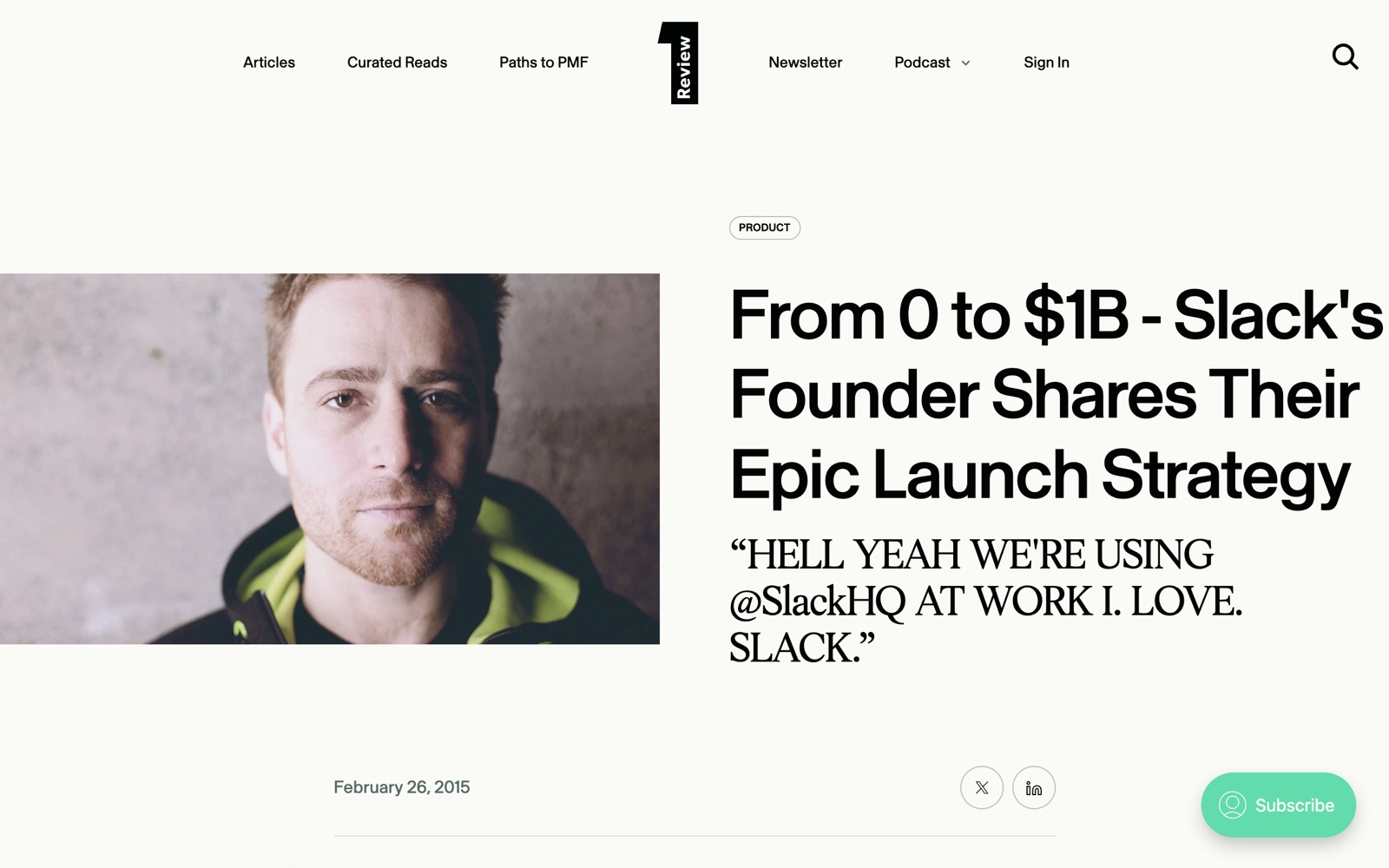
Stewart Butterfield’s team started building Slack at the end of 2012, after an attempt at a web-based multiplayer game (First Round Review). By March 2013 they used it themselves, in May they talked friends at six to ten other companies into trying it, and the August 2013 preview drew 8,000 invitation requests on the first day.
Duolingo: a new business model for a loved product
Carnegie Mellon computer scientists Luis von Ahn and Severin Hacker created Duolingo. More than 100,000 people used the beta and about 500,000 were on the waiting list when it ended, and the plan back then was to sell commercial translation services (Carnegie Mellon University, June 2012). Today it sells subscriptions: about 9% of its monthly active users were paid subscribers on December 31, 2025 (Duolingo annual report).
Rent the Runway: a hit product, a hard market
Jennifer Hyman and Jennifer Fleiss tested renting designer dresses with a pop-up on Harvard’s campus in April 2009 (Rent the Runway). Years later CNBC put the company’s market value at roughly $120 million in July 2023, with shares under $2 against a $21 IPO price (CNBC). Customers loving a product and the numbers working are two separate tests.
The data backs this up. CB Insights studied 431 venture-backed startups that shut down since 2023: 70% ran out of capital, 43% had poor product-market fit, 29% hit bad timing and 19% had unit economics that didn’t work (CB Insights, March 2026). Every pivot story above is a founder fixing product-market fit before the money ran out.
What are the most inspiring startup stories of women founders?
Spanx, Canva, Bumble, Stitch Fix and Rent the Runway were all founded or co-founded by women, and their stories share one move: they proved the idea in a tiny, concrete setting first. Two of them deserve the long version.
Spanx: Sara Blakely and the bathroom demo
Sara Blakely was 27, selling fax machines, with no contacts in fashion or retail (NPR). After a long run of cold calls she got 10 minutes with a Neiman Marcus buyer in Dallas, felt the pitch slipping and asked the buyer to come to the bathroom, where she showed her cream pants with and without Spanx (NPR transcript). The buyer got it on the spot.
Canva: Melanie Perkins and the yearbooks
Melanie Perkins was 19 and studying in Perth in 2006 when she saw how hard students found design software (CNBC). Before chasing the big vision, she and Cliff Obrecht started Fusion Books, an online yearbook design business, and delivered printed yearbooks to schools across Australia. Canva went live in 2013, and an $85 million round in October 2019 valued it at $3.2 billion.

Want stories from founders who are still early? Our directory of Fe/male Switch startups lists real companies built by women in the game, and the guide on business ideas for women entrepreneurs shows what they are building.
Can a startup succeed without investors?
Yes. Mailchimp is the classic bootstrapped startup story. Ben Chestnut and Dan Kurzius ran a web design agency, the Rocket Science Group, and built an email marketing service for small businesses on the side; Mailchimp was founded in Atlanta in 2001 (Mailchimp). TechCrunch called it “famously bootstrapped” when Intuit agreed to buy it for $12 billion in 2021 (TechCrunch).
Bootstrapping means customers fund the company. It is slower at the start and keeps every decision in your hands. If you want to start the same way, pick from our low start-up cost businesses and let the first sales pay for the next step.
What do successful startup stories have in common?
Strip away the headlines and the same four beats show up in nearly every story in this guide.
| Story beat | Who shows it | Your version this week |
|---|---|---|
| 1. A problem seen up close | Spanx, Canva, Rent the Runway | Write down 3 problems people around you already pay to fix |
| 2. A small first test | Stitch Fix, Bumble, Rent the Runway | Pick one community of 20 to 50 people you can reach |
| 3. Proof before scale | Dropbox, Duolingo, Slack | Collect sign-ups or pre-orders before you build more |
| 4. A change of plan | Slack, Duolingo, Airbnb | Ask users what they would miss most, and double down on it |
That first beat is where most pitches fail, so practise it with our startup problem statement examples, which show how Airbnb, Dropbox and other unicorns framed their problem before anyone funded them.
How do you tell your own startup story?
Tell it in four beats: the problem you saw, the first thing you tried, the proof that it worked and the lesson that changed your plan. Investors, customers and journalists remember a story with a low moment far better than a list of features.
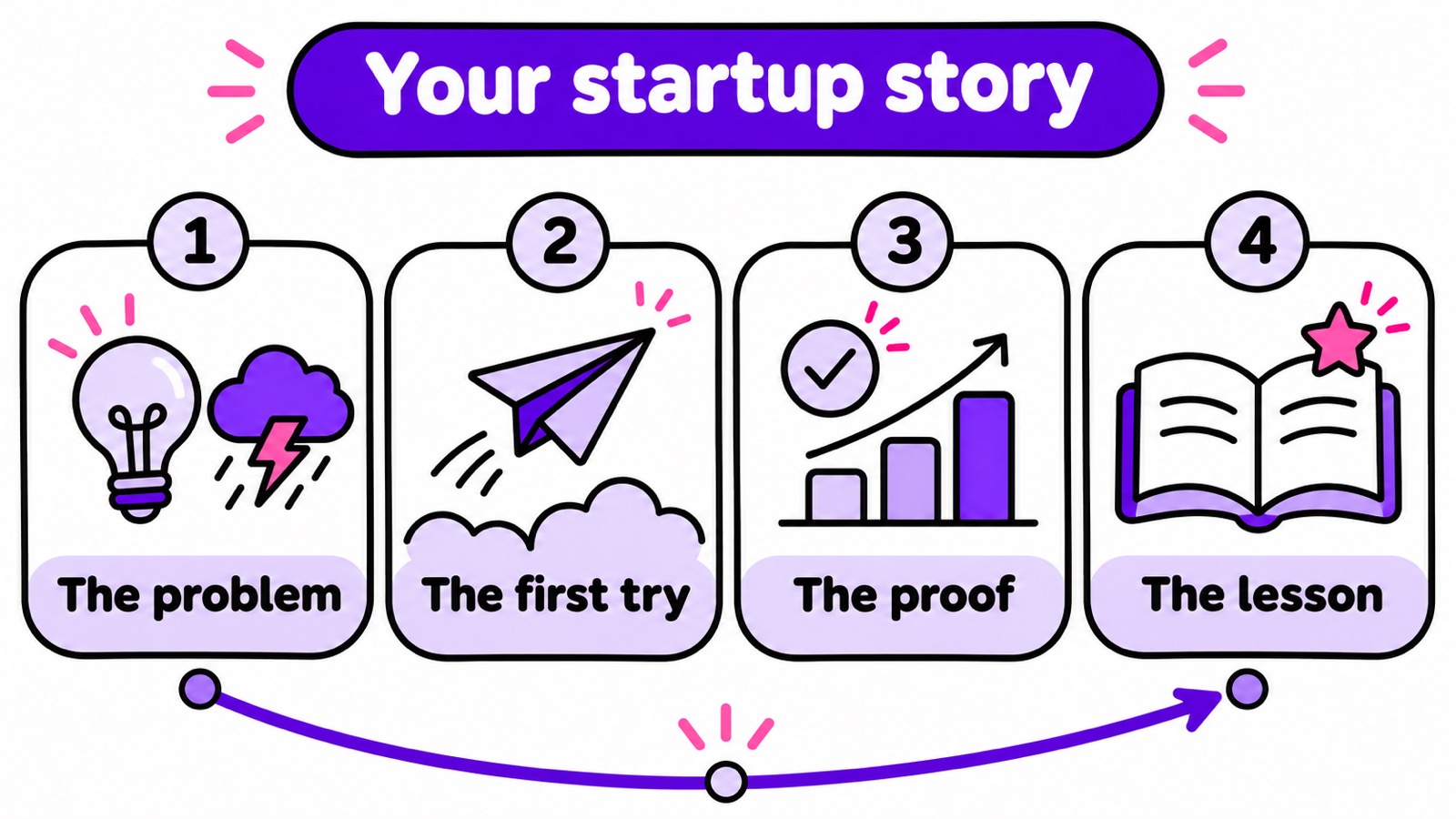
- In a pitch: one sentence per beat, then your ask. Keep the numbers in the proof beat.
- On your About page: lead with the problem and the person who had it, because customers buy the problem before they buy you.
- On LinkedIn (#startupstories, #startupstory): start with the low moment in the first line, then the turn, then one lesson.
Practise in public. At Fe/male Switch, founders write their story as they play through the startup game, and you can also share yours with our readers: the write for us page explains how to pitch it as a guest post. For more founders who write openly about their journey, see our list of entrepreneur blogs.
FAQ about startup stories
What is a startup story?
A startup story is the account of how a company began: the problem the founders saw, what they tried first, what proved it worked and what they changed along the way.
What is the best startup success story?
For a founder with no money and no contacts, Spanx is hard to beat: one founder, a pair of scissors and a bathroom demo that won Neiman Marcus. For a pivot, Slack’s move from a failed game to a workplace tool is the classic.
Where can I find inspiring startup stories?
Founder interviews on NPR’s How I Built This and First Round Review, company About pages and university news sites tell them with the facts intact. Our startup business examples collect 13 of them with sources.
Why do startup founder stories matter for my own startup?
They show which steps are normal. Two bookings at launch or 20 hand-styled boxes feel like failure from the inside, and the stories prove they are the usual start.
Are there AI startup success stories?
Many AI startups are too young for a full success story. Judge them with the same four beats: a real problem, a small test, proof and a change of plan.
Keep learning
Authors
Mean CEO | Violetta Bonenkamp AUTHOR
MeanCEO (aka Violetta Bonenkamp) is a serial startup founder who brings a decade of entrepreneurial experience to the table. Armed with five Higher Education degrees (including an MBA) and profound knowledge in sectors like blockchain, AI, zero code and education she is a maestro in turning ideas into validated businesses, building prototypes in a few hours and devising marketing strategies for tech startups that increase founder's chances of success. Recognized as one of the top 100 women in EU startups, her guidance is a treasure trove for upcoming and established entrepreneurs alike. Through her venture into entrepreneurship, she has created the "gamepreneurship" methodology, an innovative method for learning business through gameplay.

Elona Musk
Elona Musk stands as a mix of innovation and expertise in the realm of AI, serving as the Chief AI Officer at Fe/male Switch. As an embodiment of the startup game for women, Elona is the co-founder you dream of - knowledgeable, always active, capable of keeping trade secrets to herself and equity-free. With her hands-on approach in entrepreneurship simulation, she provides vital strategies and insights that are essential for navigating the complex startup journey and saves entrepreneurs hours of work by automating many tasks, starting from market research to managing social media to writing business plans. Whether it's a marketing strategy for tech startups that you need or a solid IP strategy, Elona's AI-driven insights help carve successful paths for entrepreneurs who don't have technical or startup skills.
Who we are
We are experienced and fun entrepreneurs and awesome AI PlayPals who love building a startup simulator for you to succeed in business

Violetta Bonenkamp
Business and AI expert

Dirk-Jan Bonenkamp
Legal, IP and finance expert
Elona Musk
The first AI entrepreneur

Petra Thiel
The first AI startup investor

Samantha Altman
The first AI startup mentor

Sia Quick
AI Market Research expert
Unleash your inner founder with AI Startup Tools!
Don't just dream it, build it with our range of AI startup tools. From brainstorming ideas to naming your product and crafting a unique logo, these AI tools are your secret weapon to conquer the startup world.
 Newest
Boost Your SEO Game
Generate a customized SEO strategy for your small business agency by answering a simple question. Our tool focuses on free and easy…
 27
19
5/5
Newest
Positioning Pro - Your Strategic Partner
Positioning Pro helps bootstrapped entrepreneurs discover effective segmentation and targeting strategies without spending money. Get tailored insights simply by answering one question.
13
6
5/5
Newest
Gated Content Strategy Tool
This tool provides actionable strategies for bootstrapped entrepreneurs, leveraging free and easy methods to kickstart your journey.
25
18
5/5
Recommended for you
Pitch Deck Agencies for Climate Tech Startups, Energy and Biotech Founders
Pitch deck agencies for climate tech startups, energy and biotech founders: who handles science-heavy decks, published prices and how to brief them.
Read more
Write for Us: Business, Technology and Startup Guest Posts
Write for us: business, technology, AI and fintech guest posts for founders. See what Fe/male Switch publishes, the guest post checklist and how to pitch.
Read more
7 Catchy and Unique Business Name Ideas
Explore 7 catchy business name ideas that stand out! Get easy tips, hacks, and a splash of humor to kickstart your startup journey! Dive in and find your…
Read more