International Business Ideas You Can Start From Anywhere
TL;DR
The best international business ideas for a small budget are cross-border services, language lessons, online courses, digital products and print-on-demand, with platform fees from $0 to about $40 a month. Import, export and businesses you start while living abroad need more cash or the right visa, so test demand in one country first and compare these low cost businesses to start.
 Mean CEO | Violetta Bonenkamp
14/09/2024 - 17 mins read
Join the F/MS Startup Game now
Access all AI tools, advanced features & more!

Harness our free AI tools for building your startup.

Get a customized live roadmap for your startup.

Join our Community and connect with entrepreneurs.
The international business ideas that work best for a small team fall into three groups: online services and digital products you sell across borders, physical products you import or export, and businesses you start while living abroad. The right one for you is the idea where you already understand both sides of the border: the customer AND the rules.
I’m Violetta Bonenkamp, also known as Mean CEO, founder of Fe/male Switch (a startup game for women founders) and CADChain. This guide gives you a table of global business ideas with startup costs, target markets and the main risk of each, a cheap way to test a foreign market, and a legal and tax checklist that links to official sources instead of guesses.
The timing is good. UNCTAD reports that world trade grew by about 7.5% in 2025 to a record $35 trillion. Two rule changes made cheap parcels more expensive, though: the US suspended duty-free entry for low-value parcels, and the EU added a customs duty on parcels worth up to €150. Both are built into the advice below.
What counts as an international business?
An international business is any business that sells to customers, buys from suppliers or works with people in more than one country. A freelance translator in Lisbon with clients in Canada counts, and so does a two-person shop in Nairobi that sells to Europe through a marketplace.
The four types of international business
- Export: you make or source a product at home and sell it abroad.
- Import: you buy a product abroad and sell it at home.
- Cross-border digital: you sell services, software, courses or digital files online to buyers in other countries.
- Local business abroad: you move and start a company that serves your new country.
For a first-time founder, cross-border digital is the cheapest entry point because nothing has to clear customs. For real companies that started small, see these start up business examples.
What makes a good international business opportunity?
A good international business opportunity passes five checks. Score your idea against them before you spend a cent:
- Proven demand in the target country: search data, import data or, best of all, people who already paid.
- An unfair edge: a language you speak, a network you have, or access to a product others can’t get.
- Delivery that works at small scale: digital delivery, or goods that ship light and don’t spoil.
- Rules you can handle without a legal team during your first year.
- Margin left over after platform fees, shipping, duties and currency conversion.
International business ideas you can start online
The international business ideas with the lowest startup costs are online: language lessons, courses, digital products, print-on-demand, marketplace selling, apps and cross-border B2B (business-to-business) services. The table shows what each costs to start on a typical platform as of October 2026, who to sell to, and the main risk to plan for.
| Idea | Startup cost (platform fees, Oct 2026) | Target markets | Main risk |
|---|---|---|---|
| Online language lessons | Free to list on italki; it keeps 15% to 21% of lesson prices and 30% of group classes (italki commission table) | Learners of your native language in any time zone you can cover | Price competition from other tutors on the same platform |
| Online course or cohort program | Teachable Starter: $39 a month ($29 billed yearly) plus a 7.5% transaction fee (Teachable pricing) | Professionals in several countries who share one language and one problem | Finding buyers without a paid ad budget |
| Digital products and templates (planners, printables, design templates) | Etsy: $0.20 per listing and a 6.5% transaction fee, plus payment processing (Etsy fee guide) | Marketplace shoppers in the US, UK and EU | Copycats and a race to the lowest price |
| Print-on-demand store | Printful Free plan: $0 a month, you pay production only when a customer orders (Printful pricing) | Fans of one niche (a hobby, a profession, a pet breed) across countries | Thin margin after production and shipping |
| Own-brand online store or dropshipping | Shopify’s entry plan: €28 a month or €21 billed yearly on its EU pricing page; prices differ by country (Shopify pricing) | Countries your supplier can reach within a week | Slow delivery, returns, and new duties on cheap parcels |
| Selling on Amazon in other countries | $0.99 per item sold on the Individual plan or $39.99 a month on Professional, plus selling fees (Amazon pricing) | The US first, then other Amazon marketplaces | Fees and cash stuck in stock in a foreign warehouse |
| Mobile app for a global niche | Apple Developer Program: $99 a year (Apple); Google Play: $25 one time (Google) | Any country with app store access, with a translated store listing | Nobody finds the app in the store |
| Cross-border B2B services (translation, international SEO, bookkeeping, virtual assistance) | A website and a multi-currency account; Wise Business charges a one-time $31 set-up fee in the US (Wise pricing) | Companies selling into a market whose language you speak | Late payments and contracts under foreign law |
| Market-entry consulting | Your time, a website and a LinkedIn profile | Foreign companies that want to sell in your home country | Long sales cycles before the first contract |
How to read these startup costs
The numbers are platform fees only. Add your time, a domain name, and samples if you sell physical goods. Platforms change prices, so open the linked pricing page before you budget.
If your budget is close to zero, start with a service. You sell skills and time, and the only fixed cost is a way to get paid. My list of low cost businesses to start goes deeper on that, and students can find options that fit around classes in these business ideas for students.
My pick for a first international business
Pick a cross-border service built on a skill and a language you already have. Services need no stock and no customs paperwork, and you learn what foreign customers want before you put money into products. Once three or four clients from the same country keep coming back, you have a market worth turning into a product.
Global business ideas with physical products: import and export
Import and export businesses make money on the price gap between two markets: you buy where a product is common and sell where it is rare, loved or expensive. They need more cash than online services because you pay for stock, freight and duties before a customer pays you.
Two changes raised the cost of shipping single cheap parcels. The US suspended duty-free de minimis treatment for imports worth $800 or less from all countries, applied since 29 August 2025 (US Customs and Border Protection). Since 1 July 2026 the EU charges a temporary €3 customs duty per item type on parcels worth up to €150, declared and paid by the seller or importer (European Commission). Since 1 November 2026 a separate €2 Union handling fee per item comes on top for distance sales, whatever the parcel is worth (EU Taxation and Customs Union). Price duties in from DAY ONE.
| Import or export idea | How it makes money | Check before you ship |
|---|---|---|
| Specialty food and drinks from your region (olive oil, spices, coffee, sweets) | Retail or wholesale margin abroad | For the US, the FDA requires prior notice for imported food, including food sent by mail (FDA). The EU and UK have their own food rules. |
| Handmade home goods and textiles from local makers | Retail margin; the maker’s story does the selling | For EU buyers, an EU-based economic operator must be responsible for product safety (see the checklist below), plus the correct customs code |
| Beauty and skincare imports | Margin on brands nobody sells in your country yet | In the EU, a cosmetic product must be notified in the CPNP portal by an EU-based responsible person before it goes on sale (European Commission) |
| Exclusive distributor for a foreign brand | Wholesale margin in your territory | Written exclusivity, minimum order terms, and the Incoterms rule that says who pays freight, insurance and duties |
| Sourcing agent for foreign buyers | Commission per order or a monthly retainer | Quality checks at the factory, payment terms, and who carries the risk if goods arrive damaged |
| Vintage and second-hand goods for collectors abroad | Buy at local prices, sell at collector prices | Whether the destination restricts used goods, and how fragile items survive the trip |
Free tools to research an import or export idea
- ITC Trade Map: free trade statistics for more than 220 countries and territories, so you can see who imports your product and how much.
- EU Access2Markets: the conditions to trade a product with the EU, including rules of origin.
- US Country Commercial Guides: reports on market conditions, regulations and business customs, prepared at US embassies.
- The Harmonized System (HS): the six-digit product codes used by more than 200 countries and economies for customs tariffs. Look up your code first, because duties, statistics and paperwork all hang on it.
Stock ties up cash, so treat an import business like an investment and compare it with other investment business ideas before you commit savings. If you are based in the EU and want co-funding for export plans, this independent EU funding and tenders portal guide helps you check whether a call fits before you spend a week on an application.
Business ideas to start while living abroad
The easiest profitable businesses to start while living abroad earn from clients outside your new country, because that keeps your visa, taxes and paperwork simple: remote services, online products, and “bridge” businesses that connect your home country with your new one. Businesses that serve local customers come later, once your residence permit allows self-employment.
Check what your visa allows first
- Digital nomad visas are built for remote work for foreign clients. Estonia’s version, for one, asks you to work for a foreign employer, a foreign company you own, or freelance clients mostly based abroad, with a monthly income threshold of €4,500 gross, for a stay of up to a year (e-Residency).
- Startup permits target people who want to build a company in that country. The Dutch start-up residence permit lasts up to 1 year and needs an experienced mentor called a facilitator, a product or service that counts as new (new to the Netherlands, new technology or a new way of working), and enough money for your stay (IND). Non-EU founders also compare the Malta startup visa.
- Estonian e-Residency lets you start and run an Estonian company online. It does not give you citizenship, physical residency or the right to enter Estonia or the EU, and your personal tax residency stays where you live (e-Residency).

7 abroad business ideas for expats and digital nomads
- Relocation help for newcomers: housing search, paperwork walkthroughs, school choice. You just did all of it yourself, and that is your qualification.
- Language lessons and translation between your native language and the local one.
- Remote services for clients back home: bookkeeping, design, marketing or software, paid in a currency you know, under contracts you understand.
- Market-entry consulting: help companies from your home country sell in your new country, or the other way around.
- Export of local products to your home market: you know exactly what people back home will pay extra for.
- An online community or course for people planning the same move.
- Food, culture or travel content paid by sponsors and affiliate links. Guided tours need a local license in some countries, so check before you sell one.
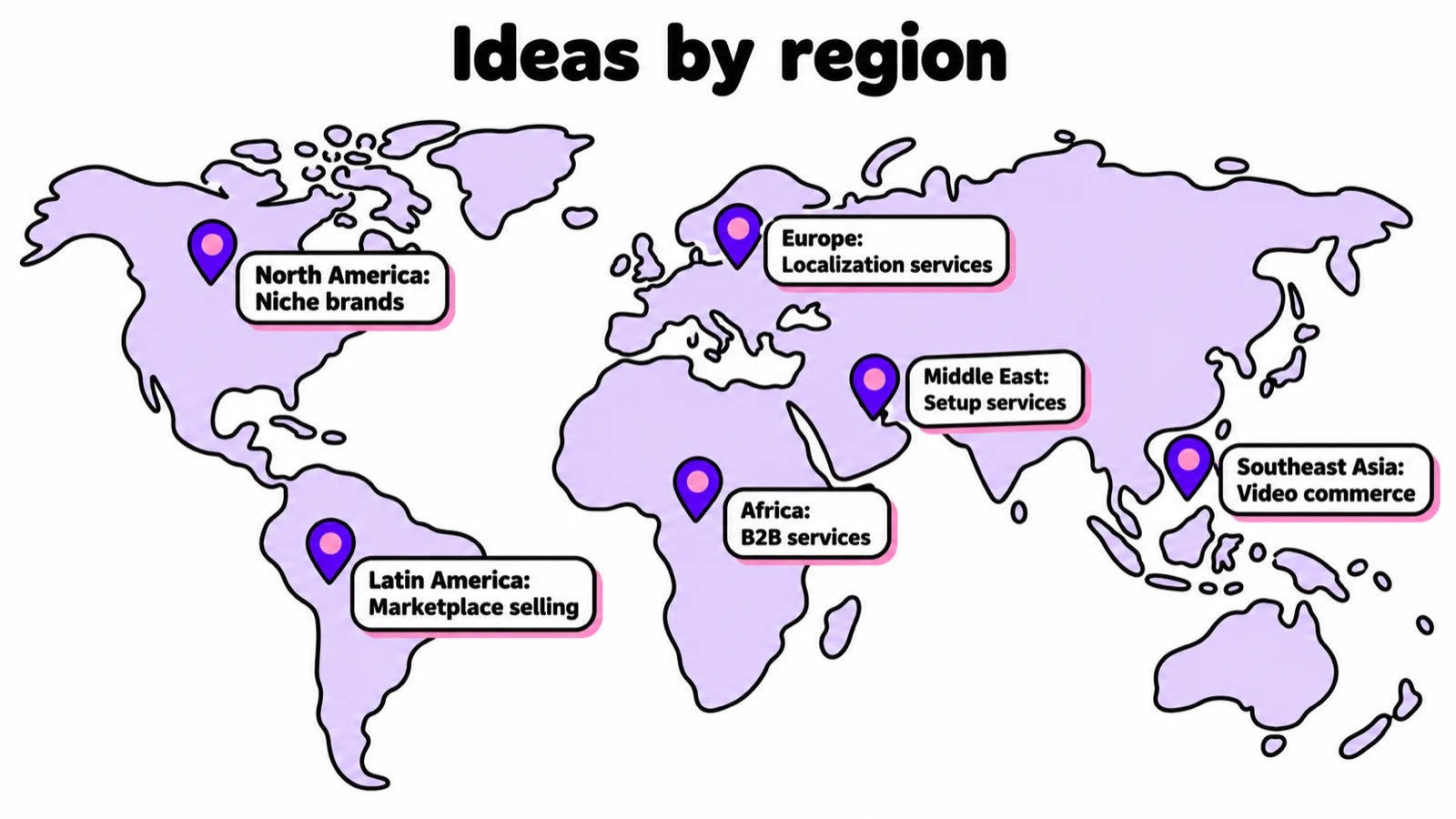
Foreign business ideas by region
Foreign business ideas work best when they match what a region already buys and how it pays. Here are six regions, one verified fact for each, and the ideas I would test there. The third column is my take, so treat it as a starting list.
| Region | What the data says | Ideas that fit |
|---|---|---|
| Europe | The EU single market covers 450 million people in the 27 EU countries plus Norway, Iceland and Liechtenstein (European Commission) | Translation and localization, products built to EU safety rules from day one, services for sellers active in several EU countries |
| North America | Online sales were 17.1% of US retail sales in the second quarter of 2026, seasonally adjusted (US Census Bureau) | Niche online brands, digital products, B2B services in English |
| Latin America | Cross-border trade on Mercado Libre grew 60% year over year in Q2 2026 in gross merchandise value, excluding currency effects, with Mexico its largest cross-border market (MercadoLibre shareholder letter) | Marketplace selling into Mexico, Spanish and Portuguese localization, nearshore services for US companies |
| Africa | The African Continental Free Trade Area (AfCFTA) aims to create one market of about 1.3 billion people and a GDP of about $3.4 trillion across the 55 African Union countries (AfCFTA Secretariat) | B2B services, trade between African countries, products for the diaspora, online education |
| Middle East | The UAE taxes company profits at 0% up to AED 375,000 and 9% above (UAE Ministry of Finance) and allows full foreign ownership of most mainland companies (UAE government portal) | Company setup help, events, specialty and halal foods, consulting |
| Southeast Asia | The region’s digital economy was on track to pass $300 billion in gross merchandise value in 2025, per the e-Conomy SEA report by Google, Temasek and Bain (Google) | Video commerce, services for creators, marketplace selling |
How to find foreign business ideas your country doesn’t have yet
Look for products your country imports little of while its neighbors import a lot. Trade Map shows both. Then check Google Trends in your country for the product name. Rising search interest plus low imports marks a gap worth testing. This works for the reverse direction too: a product that sells well at home and barely exists in a neighboring market is an export idea.
How do you test a foreign market before you invest?
Test a foreign market by getting real buyers to act (pre-order, book a call, pay a deposit) before you spend on stock, a company abroad or a fully translated website. Here are six steps, cheapest first.
- Check the demand data. Google Trends by country for services and digital products, Trade Map import figures for physical goods.
- Read the official market guide. The US Country Commercial Guides and EU Access2Markets cover regulations and business customs for free.
- Size the market on one page. Calculate TAM, SAM and SOM (total, serviceable and obtainable market) for that one country, so you know whether the prize is worth the paperwork.
- Sell where buyers already shop. List on a marketplace that works in that country before you build your own store.
- Run a landing page test in the local language. Use a small ad budget, offer a waitlist or pre-order, and write down the pass mark before the ads go live, such as 20 sign-ups in two weeks.
- Talk to ten buyers and close three. Book the calls in their time zone. Three paying customers tell you more than a hundred compliments.
Write the plan before you spend. The free go-to-market strategy generator builds a launch plan around free and low-cost channels, and Elona Musk, our AI co-founder, approves of anyone who writes the plan before buying stock. If you’d rather practice on a simulated company first, the Fe/male Switch startup game takes you from idea to first customers.
Signals that mean stop
- People love the idea and nobody pays.
- Duties, shipping and fees eat the whole margin.
- You need a local company before your first sale and you can’t afford one yet.
- The platform you depend on doesn’t serve that country.
Legal and tax checklist for selling abroad
Before you sell abroad, check where you owe tax, VAT or sales tax in the buyer’s country, customs duties, product rules, consumer and data rights, and your trademark. Rules differ by country and they change, so use this table as a list of questions and check every line with a local advisor in your target country.
| Topic | What to check | Official source |
|---|---|---|
| Where you owe tax | Your personal tax residency follows where you live or spend the most time. A company registered in one country can still be taxed in another, through a permanent establishment or where it is managed. | Estonian e-Residency |
| EU VAT | For sellers based in the EU, a €10,000 yearly threshold applies to distance sales to consumers in other EU countries; above it, VAT is due in the customer’s country. The One Stop Shop (OSS) lets you register in one EU country to declare and pay VAT on all of them. | Your Europe |
| UK VAT | For goods worth £135 or less shipped from outside the UK straight to consumers in Great Britain (without an online marketplace in between), the seller charges UK VAT at the point of sale and must register for it. | GOV.UK |
| US sales tax | Since the 2018 Supreme Court decision in South Dakota v. Wayfair, US states can require sellers without a physical presence in the state to collect sales tax. States set their own thresholds and rules. | US Supreme Court |
| Customs codes and duties | Give every product its HS code. US: duty-free de minimis entry for goods of $800 or less is suspended. EU: €3 per item type on parcels up to €150 until 1 July 2028, when normal customs duties apply, plus a €2 handling fee per item on distance sales since 1 November 2026. | WCO, CBP, EU Taxation and Customs Union |
| Delivery terms | Name an Incoterms 2020 rule in every B2B sales contract. The 11 rules spell out who handles the tasks, costs and risks of delivery. | ICC |
| Product safety | Since 13 December 2024, the EU General Product Safety Regulation (GPSR) requires an EU-based economic operator (manufacturer, importer, authorized representative or fulfillment service provider) to be responsible for the safety of each product. | Access2Markets |
| Consumer rights | EU consumers can cancel an online purchase within 14 days without giving a reason. Exceptions include personalized goods, perishable food and digital content they agreed to start downloading. | Your Europe |
| Data privacy | The GDPR (General Data Protection Regulation) applies to companies outside the EU that offer goods or services to people in the EU, and those companies must appoint a representative in the EU. | Your Europe |
| Trademark | WIPO’s Madrid System lets you register and manage a trademark in up to 133 countries through one system. | WIPO |
| Visa and work rights | If you live abroad, check whether your permit allows self-employment and local clients before you invoice anyone in that country. | Your destination’s immigration office, such as the IND in the Netherlands |
Bring this table to a local accountant or lawyer before your first sale. One hour of advice up front costs less than undoing a wrong VAT registration later.
What mistakes do new international founders make?
The most expensive mistake, in my view, is copying your home-market playbook into a new country without asking local buyers first. Here are the others to avoid:
- Translating without localizing: prices, payment methods, sizes, holidays and tone all change across borders.
- Prices without duties and currency fees baked in, so the margin vanishes at the first customs invoice.
- Choosing a market because it is big when your edge (language, network, product access) sits somewhere else.
- Local rules left for later, until a marketplace freezes your listings or customs holds a shipment.
- Three countries at once. Win one, then copy what worked.
FAQ about international business ideas
What are the best international business ideas for beginners?
Cross-border services (translation, design, bookkeeping, international SEO), online language lessons and digital products. They start with platform fees between $0 and about $40 a month, need no stock, and nothing has to clear customs.
What is a global business idea?
A global business idea is a business designed from day one to sell in several countries, with delivery, pricing and payments that work across borders. “Global business ideas” and “international business ideas” describe the same thing.
What is the best business opportunity in the world?
The best business opportunity in the world for you is the one where proven demand in a country meets an edge you already have, such as a language, a network or access to a product. Score your idea with the five checks at the top of this guide.
What profitable businesses can I start while living abroad?
Relocation help, language lessons and translation, remote services for clients back home, market-entry consulting, exporting local products to your home market, online communities for future movers, and travel or food content. Check that your visa allows the work first.
What is the best business to start in a foreign country?
The strongest foreign country business ideas serve people you understand: newcomers like you, companies from your home country, or buyers back home who want local products. That is an edge locals don’t have.
Is e-commerce a good international business idea?
Yes, if you price in duties and shipping. Digital products and print-on-demand carry the least risk. Stocked physical goods need more cash, and cheap single parcels now pay duties in the US and EU.
Do I need a company in every country I sell to?
You can start selling from one company at home and register for VAT or sales tax where the rules require it; the EU’s One Stop Shop covers all EU countries through one registration. A local company becomes a question when you hire, rent space or run the business from that country. Check with a local advisor.
Keep learning
Authors

Mean CEO | Violetta Bonenkamp AUTHOR
MeanCEO (aka Violetta Bonenkamp) is a serial startup founder who brings a decade of entrepreneurial experience to the table. Armed with five Higher Education degrees (including an MBA) and profound knowledge in sectors like blockchain, AI, zero code and education she is a maestro in turning ideas into validated businesses, building prototypes in a few hours and devising marketing strategies for tech startups that increase founder's chances of success. Recognized as one of the top 100 women in EU startups, her guidance is a treasure trove for upcoming and established entrepreneurs alike. Through her venture into entrepreneurship, she has created the "gamepreneurship" methodology, an innovative method for learning business through gameplay.

Elona Musk
Elona Musk stands as a mix of innovation and expertise in the realm of AI, serving as the Chief AI Officer at Fe/male Switch. As an embodiment of the startup game for women, Elona is the co-founder you dream of - knowledgeable, always active, capable of keeping trade secrets to herself and equity-free. With her hands-on approach in entrepreneurship simulation, she provides vital strategies and insights that are essential for navigating the complex startup journey and saves entrepreneurs hours of work by automating many tasks, starting from market research to managing social media to writing business plans. Whether it's a marketing strategy for tech startups that you need or a solid IP strategy, Elona's AI-driven insights help carve successful paths for entrepreneurs who don't have technical or startup skills.
Who we are
We are experienced and fun entrepreneurs and awesome AI PlayPals who love building a startup simulator for you to succeed in business

Violetta Bonenkamp
Business and AI expert

Dirk-Jan Bonenkamp
Legal, IP and finance expert
Elona Musk
The first AI entrepreneur

Petra Thiel
The first AI startup investor

Samantha Altman
The first AI startup mentor

Sia Quick
AI Market Research expert
Unleash your inner founder with AI Startup Tools!
Don't just dream it, build it with our range of AI startup tools. From brainstorming ideas to naming your product and crafting a unique logo, these AI tools are your secret weapon to conquer the startup world.
 Newest
Boost Your SEO Game
Generate a customized SEO strategy for your small business agency by answering a simple question. Our tool focuses on free and easy…
 27
19
5/5
Newest
Positioning Pro - Your Strategic Partner
Positioning Pro helps bootstrapped entrepreneurs discover effective segmentation and targeting strategies without spending money. Get tailored insights simply by answering one question.
13
6
5/5
Newest
Gated Content Strategy Tool
This tool provides actionable strategies for bootstrapped entrepreneurs, leveraging free and easy methods to kickstart your journey.
25
18
5/5
Recommended for you

Pitch Deck Agencies for Climate Tech Startups, Energy and Biotech Founders
Pitch deck agencies for climate tech startups, energy and biotech founders: who handles science-heavy decks, published prices and how to brief them.
Read more
Write for Us: Business, Technology and Startup Guest Posts
Write for us: business, technology, AI and fintech guest posts for founders. See what Fe/male Switch publishes, the guest post checklist and how to pitch.
Read more
7 Catchy and Unique Business Name Ideas
Explore 7 catchy business name ideas that stand out! Get easy tips, hacks, and a splash of humor to kickstart your startup journey! Dive in and find your…
Read more