Business Ideas for Students: Online and Campus Ideas
TL;DR
The best business ideas for students are services and small digital products you can start for $0: tutoring, freelance writing or design, social media help, digital templates and campus services like move-out help. Pick the idea that fits the hours you can protect each week, put platform fees into your price and check your visa, housing and tax rules before your first sale. For a personalized starting point, try our free give me a business idea tool.
 Mean CEO | Violetta Bonenkamp
09/09/2024 - 18 mins read
Join the F/MS Startup Game now
Access all AI tools, advanced features & more!

Harness our free AI tools for building your startup.

Get a customized live roadmap for your startup.

Join our Community and connect with entrepreneurs.
The best business ideas for students fit around a class schedule, cost close to nothing to start and use a skill you already have: tutoring, freelance writing or design, social media help for local shops, reselling, digital templates and campus services like move-out help. This guide sorts every idea by startup cost, hours per week and skills, with the real platform fees linked (as of October 2026), so you can pick one tonight and test it this week.
I’m Violetta Bonenkamp, also known as Mean CEO, founder of Fe/male Switch, a startup game for women founders, and of CADChain. You are in good company: the GUESSS Global Report 2025, based on 196,162 student responses from 66 countries, found that 16.5% of students are in the process of founding a business and 6.4% already own and run one. This page is the HUB of our student guides, so each section also points you to the deeper guide for your situation: teen ideas, college startups, class projects and business games.
What are the best business ideas for students?
The best business ideas for students are services and small digital products, because they need a laptop and a skill instead of stock or a loan. Here is the quick list, roughly from the cheapest to start to the most expensive:
- Online tutoring in a subject you aced
- Freelance writing, editing or proofreading
- Graphic design for clubs, events and local shops
- Social media management for small businesses near campus
- Video editing for creators
- Digital templates like study planners, résumé templates and budget spreadsheets
- Print-on-demand merch with campus jokes or club designs
- Reselling secondhand clothes and textbooks
- Move-out and move-in help at the end and start of term
- A small online store for a product you design
How to choose a student business idea in 10 minutes
Run each idea through four filters. The one that survives all four wins, even if it sounds boring.
- Hours: count the hours you can protect every week during exam season, when your week is at its worst. That number decides your idea more than passion does.
- Cash: with less than $50 to spare, pick a service. Products come later, paid for by service income.
- Skill: choose something friends already ask you to help with. Those requests are free market research.
- Customers: write down 10 real people or businesses who could pay you this month. Fewer than 10 names means you need a different idea.
If none of the ideas clicks yet, type your interests and skills into our free give me a business idea tool. It returns a personalized idea you can build without technical skills, plus first steps. Elona Musk, our AI co-founder, fully approves of this shortcut.
For readers under 18, platform age limits, parental consent and school-friendly ideas sit in our youth business ideas guide, which sorts ideas by age (13 to 15, 16 to 18 and 18 to 25). This page focuses on students who can already sign up for freelance platforms and receive payments.
Online business ideas for students
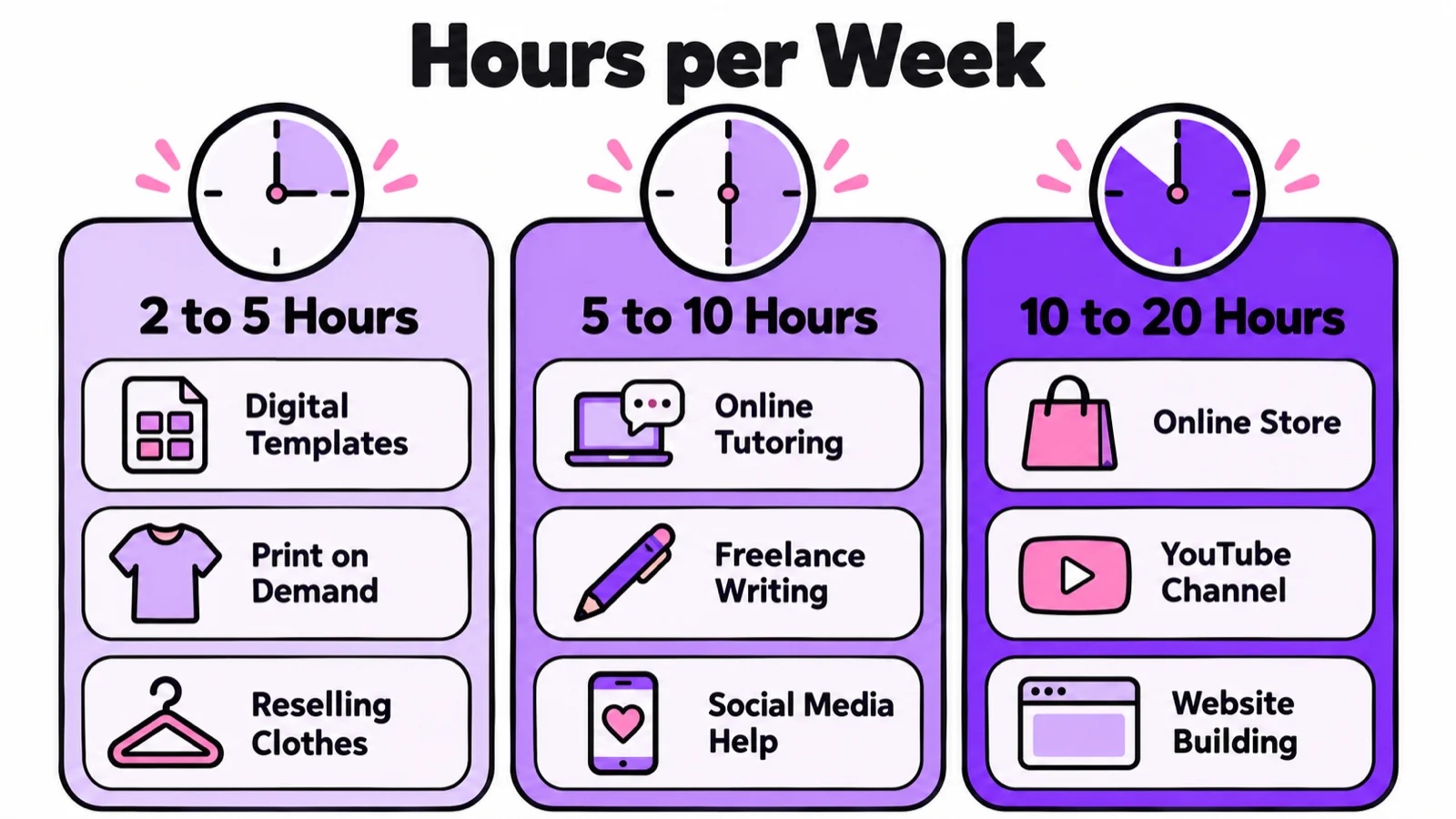
The best online business ideas for students are freelance services, tutoring and digital products, since you can start them for $0 with the laptop you already own and pay platform fees only when you earn. The table shows each idea with its startup cost, a realistic hours-per-week range, the skills it needs and how it earns.
Fees come from each platform’s own pricing or help page as of October 2026. The hours are my planning ranges for a normal semester week, so treat them as a budget, and expect the first month to take longer.
| Idea | Startup cost and fees | Hours per week | Skills | How it earns |
|---|---|---|---|---|
| Online tutoring | $0. Preply keeps 100% of each trial lesson with a new student, then 18% to 33% of later lessons | 5 to 10 | One subject you know cold, patience | Hourly lessons, packages of 5 or 10 sessions |
| Freelance writing and editing | $0. On Fiverr you earn 80% of each order | 5 to 10 | Clear writing, deadlines | Per project or per 1,000 words |
| Graphic design | $0 with Canva’s free plan | 5 to 10 | Layout, fonts, taste | Per design or monthly package |
| Social media management | $0 | 5 to 10 for 1 or 2 clients | Short posts, phone video, consistency | Monthly fee per business |
| Video editing for creators | $0 with free editing software | 5 to 10 | Cutting, captions, pacing | Per video or per batch |
| Virtual assistant work | $0. Upwork charges freelancers a service fee of 0% to 15%, set per contract | 5 to 10 | Organization, email, research | Hourly or fixed-price contracts |
| Handmade goods on Etsy | Etsy: $0.20 per listing and a 6.5% transaction fee, plus payment processing of 3% + $0.25 per order for US sellers; a one-time shop set-up fee can apply | 5 to 10 | Making things, product photos | Margin per item |
| Digital templates and study planners | $0. Gumroad keeps 10% + $0.50 per direct sale and 30% on sales through its Discover marketplace | 10 to 15 to build once, then 2 to 5 | Design, Notion or spreadsheets | Per download |
| Print-on-demand merch | $0 upfront with Printful: you pay for printing only after a customer orders | 2 to 5 | Design, niche humor | Margin per item |
| Reselling clothes and textbooks | The cost of your stock. Vinted charges sellers no fees | 2 to 5 | Spotting brands, photos, pricing | Buy low, sell higher |
| Website building for local businesses | $0 (the client pays for the domain and hosting) | 10 to 20 per project | No-code site builders, writing | Per project, plus monthly updates |
| YouTube or content creation | $0 with your phone. Ad revenue needs 1,000 subscribers plus 4,000 watch hours in 12 months or 10 million Shorts views in 90 days | 10 to 20 | Comfort on camera, editing, patience | Ads, sponsorships, affiliate links |
| Small online store | Shopify: 3 days free, then €1 a month for 3 months, then plans from €28 a month on monthly billing (EU prices) | 10 to 20 | Product research, ads, customer service | Product margin |
Which online business pays students fastest?
Services pay fastest. One tutoring student or one design order can pay you this week, while a YouTube channel earns nothing from ads until it reaches 1,000 subscribers and 4,000 watch hours. The bar is rising too: from 1 February 2027, new channels need 8,000 watch hours or 20 million Shorts views to join the partner program, according to YouTube’s announced changes. My advice: run content as a slow side project next to a service that pays your bills.
Do the fee math before you set a price
Platform fees decide your REAL hourly rate. A $50 Fiverr order leaves you $40. A $10 Gumroad template leaves you at most $8.50 after the 10% + $0.50 fee. A $20 sticker set on Etsy costs you $0.20 to list, $1.30 in transaction fees and $0.85 in US payment processing, so you keep $17.65 before materials and shipping. Put those numbers in your price from day one, and raise prices after your first five happy customers.
If money is your tightest limit and you are open to ideas beyond student life, our low cost business to start guide ranks ideas for anyone by real startup cost, from $0 up to about $1,000.
Campus business ideas for college students
Campus business ideas work because your customers live a short walk away and their needs peak on dates you know months ahead: move-in week, exam weeks and graduation. Plan your year around those peaks and you get busy weeks you can schedule around your classes.
| Campus idea | Peak dates | What you need | Check first |
|---|---|---|---|
| Move-out pickup and summer storage | End of the spring term | A rented van for peak days, storage space | Insurance and who pays for damage |
| Textbook and dorm-gear resale | First and last two weeks of term | Cash for stock, a spreadsheet | The campus bookstore’s buyback price, which you have to beat |
| Exam prep sessions | Two weeks before midterms and finals | A bookable room, your own notes | Academic integrity rules: teach, and never sell graded work or answers |
| Graduation and club photos | Graduation season, society events | A camera you own or borrow | Photo rules for campus venues |
| Club and society merch | Start of the year, sports and society events | Pre-orders, print on demand or a local printer | Your university’s trademark rules before you print its name or logo |
| Tech setup and repair | Move-in week | A small tool kit | Written terms on who pays if a device breaks |
| Laundry pickup and room cleaning | Exam weeks | Bags, detergent, a schedule | Housing access rules for non-residents |
| Care packages ordered by parents | Exam weeks, birthdays | A supplier, boxes, a simple order form | Food labeling rules if you include snacks |
Read your housing rules before you start
One rule catches campus founders off guard: residence hall policies. UNC Charlotte’s residence hall policy lets students use their rooms for infrequent sales but does not allow a student to operate a continuing business from a private room. Read your own housing contract and solicitation policy before your dorm room turns into a warehouse.
Test it with a pop-up, the Rent the Runway way
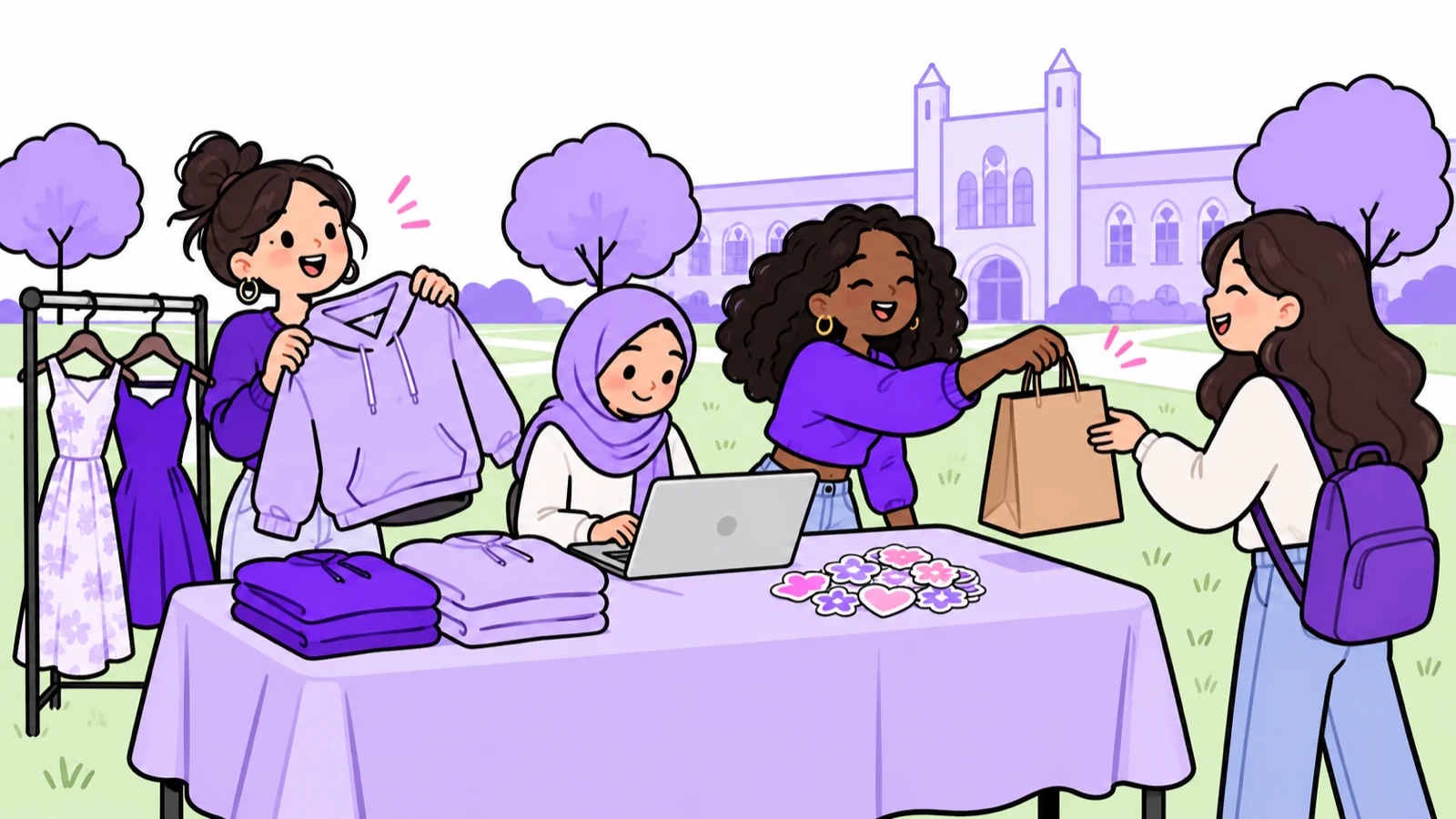
The cleanest campus test I know comes from Rent the Runway. Jenn Hyman shared the idea of renting designer items with her friend Jenny Fleiss at Harvard Business School in November 2008, and in April 2009 they and Jenn’s sister Becky set up a pop-up shop on Harvard’s campus where students could try on and rent dresses on the spot, according to the company’s own story. A pop-up like that gives you real customers, real objections and real prices in a single afternoon, for the cost of a table.
When you are ready to turn a campus idea into a real startup, our startup business ideas for college students guide goes deeper on finding your niche, checking feasibility and using the resources your campus already offers.
Unique business product ideas for students
Unique product ideas for students solve a small, specific student problem or carry an identity people like to show off, such as a club, a campus joke or a city. Start with products you can pre-sell or print on demand, so you never sit on a box of unsold stock.
| Product idea | Why students buy it | How to make it | First test |
|---|---|---|---|
| Campus stickers, posters and postcards | Local pride, inside jokes | Print on demand or a local print shop | Pre-orders in three class group chats |
| Club and society hoodies | Belonging, events | Bulk order once pre-orders are in | Collect deposits before you order |
| Digital study planners and templates | Exam stress | Notion, Google Sheets or Canva, sold on Gumroad | Free version first, paid version after 50 downloads |
| Upcycled thrift clothing | One of a kind, cheap | Thrift finds plus sewing | List 10 pieces on Vinted |
| Flashcard packs for international students | Language and exam prep | Printable or digital decks | Sell to one language club |
| Dorm starter kits | Convenience for first-years and their parents | Bundles of items bought in bulk | Pre-sell to parents before move-in |
| Handmade jewelry or crochet | Gifts, birthdays | Made at your desk | Five Etsy listings at $0.20 each |
| Budget student cookbook | Cheaper food, less takeout | An e-book with your own recipes and photos | Sell the first 20 copies to friends of friends |
These double as creative business ideas for students and as entrepreneurship product ideas for a class project, since each one can be designed, priced and sold within one semester.
A word on food and cosmetics: candles, snacks, soaps and lip balms come with safety and labeling rules that differ by country and state. Check the local rules before you sell anything people eat, burn or put on their skin.
Startup ideas for students with growth potential
A student startup idea has growth potential when a specific group has a frequent, expensive problem and your solution can serve customer number 1,000 without needing 1,000 times your hours. Tutoring pays from week one and stops when you stop; software for student clubs pays nothing for months and can then serve every club in the country.
| Startup idea | Who pays | Two-week test without code |
|---|---|---|
| Membership and dues software for student clubs | Clubs, student unions | Run one club’s dues with a form and a spreadsheet |
| First-week help desk for international students (housing, paperwork, arrival) | Students, parents, universities | A landing page and 20 sign-ups before move-in |
| Campus marketplace for textbooks and dorm gear | Sellers, through a small fee | A group chat plus a spreadsheet for one dorm |
| Study tool that turns your own notes into quizzes | Students, by subscription | Make quizzes by hand for 10 classmates |
| Discounted canteen leftovers | Cafés and canteens | One café, one week, one pickup time |
| Accessibility tools for lectures (captions, note formats) | University disability services | Five interviews with the disability office and students |
| Research spin-off from a university lab | Licensing customers, investors | A meeting with your tech transfer office |
Student founders who started on campus
Michael Dell began small: in his first year at the University of Texas he sold computer parts out of his dorm room, and he founded his company in that room in 1984, according to the Academy of Achievement. The pattern is the same as Rent the Runway’s pop-up: a tiny test with real buyers came first, the company came later.
Timing is on your side. In the GUESSS 2025 data, 43.4% of students who are in the middle of starting a business expect to finish founding it while still studying, and another 38.1% within two years of graduating. The two largest sectors they named were the “orange economy” (arts, music, fashion and design, 20.2%) and the “yellow economy” (IT, AI and digitalization, 18.9%).
The same report shows a gender gap: 4.9% of female students already run a business, against 8.2% of male students. Closing that gap is what Fe/male Switch, our startup game, is for: you take your idea to first customers in a game setting before you risk your savings.
Student programs that fund the next step
Once the idea shows signs of life, student programs can pay for the next step. The Hult Prize calls itself the world’s largest student startup competition, and its winning team receives 1 million USD in seed funding. Y Combinator lets current students apply for the batch that starts after they graduate, which it calls Early Decision.
Already picked your startup idea and want the next steps, such as a business plan, a support network and staying motivated? Our business startup ideas for students guide covers them.
Business ideas for an entrepreneurship class
The best business ideas for an entrepreneurship class are small enough to test inside one semester: you interview real customers, sell something real and present numbers instead of guesses.
The Stanford $5 challenge
My favorite class format comes from Stanford. Professor Tina Seelig gave 14 teams an envelope with $5 and two hours to make as much money as possible, followed by a three-minute presentation, as she describes in her account of the $5 challenge. The winning teams brought in over $600, and the top team made $650 by selling its three-minute presentation slot to a company recruiting students in the class. The teams that did best ignored the $5 and looked for problems people would pay to have solved.
| Class project | Time | What students hand in |
|---|---|---|
| The $5 challenge | One week, with a two-hour selling window | One slide, a three-minute pitch, the money earned |
| 10 customer interviews on one campus problem | Two weeks | A problem statement backed by quotes |
| Business Model Canvas of a local business | One week | A filled canvas with all nine blocks of the Strategyzer Business Model Canvas |
| Pop-up stand for a product the team made | Two to three weeks | A sales sheet, costs and what the team would change |
| Three paying clients for a service | Two weeks | Receipts and the price the team settled on |
| Social enterprise pitch | Four to six weeks | A pitch deck aimed at a student competition such as the Hult Prize |
| Business game round | One or two class sessions | Game results and a short reflection |
For a graded school project, our business project ideas page adds a grading rubric and a project outline template. Teachers who want students to practice decisions before touching real money can pick from our business games for students, which compares online and classroom games.
How do you run a business while studying?
Run it like an extra course: a fixed number of hours on your calendar, a separate place for the money and a 30-minute check of the legal rules before your first sale.
Time: budget your hours like credits
Pick your weekly hours from the table above, then cut them in half for exam weeks. Batch the work into two fixed blocks a week, say Tuesday evening and Saturday morning, since ten scattered half-hours get eaten by lectures and group projects. Tell clients your response time up front (“replies within 24 hours on weekdays”), and you will never answer client emails in the middle of a lecture again.
International students have a hard ceiling. The US government’s Study in the States guide says F-1 students in on-campus jobs may not work more than 20 hours a week while school is in session, off-campus work opens only after a full academic year and under specific conditions, and working without permission can end your student status. The UK Student visa page states plainly that you cannot be self-employed. Talk to your international student office before you take a single paid order.
Money: keep it separate from day one
- A separate account or card for business money, so your rent never pays for stock
- One simple sheet with date, customer, amount, platform fee and what you kept
- A tax pot: move part of every payment aside, since freelance income reaches you before income tax
- Prices set after fees, using the fee math from the online section
Legal checks before your first sale
The rules depend on your country, state and visa. This checklist gives you the questions to ask; for the answers, check official sources or ask an accountant.
- Registration: find out whether you must register as a sole proprietor (sole trader) before your first sale or only above a certain income.
- Tax thresholds: in the US, the IRS requires self-employment tax and Schedule SE once your net earnings from self-employment reach $400. In the UK, the trading allowance lets you earn up to £1,000 of trading income a tax year tax-free.
- University rules: housing, academic integrity, logo use and the intellectual property policy if you build with university labs, money or staff.
- Platform terms: minimum age and rules about moving clients off the platform.
- A one-page agreement for physical services like moving or repairs, covering what happens if something breaks.
Check your country’s rules before you rely on any threshold here. Tax and registration rules change, and the numbers above apply only to the US and UK as of October 2026.
Sell first, plan second
GUESSS asked 26,642 student founders who were in the middle of starting a business which steps they had already taken. Writing a business plan was almost twice as common as making a sale:
| Step already taken | Share of student founders |
|---|---|
| Collected information about markets or competitors | 54.0% |
| Discussed the idea with potential customers | 46.8% |
| Wrote a business plan | 43.7% |
| Started developing the product or service | 38.6% |
| Started marketing | 26.8% |
| Bought material or equipment | 25.3% |
| Sold a product or service | 22.7% |
| Tried to get outside funding | 13.7% |
| Registered the business | 11.8% |
Source: GUESSS Global Report 2025, nascent entrepreneurs.
My take: FLIP THE ORDER. Talk to 10 customers, sell to three of them, then write a one-page plan with real numbers in it. Your plan will change anyway: only 34.1% of student business owners in the same survey said their original idea had never changed.
FAQ about business ideas for students
What is the best business idea for students?
Online tutoring or freelancing in a skill you already have. Both cost $0 to start, pay per hour or per project and fit around classes. Choose the one where you can name 10 possible customers today.
What business can a student start with no money?
Tutoring, freelance writing, graphic design, social media management, video editing and exam prep sessions all start at $0. Print-on-demand merch also needs no upfront money with services like Printful, because you pay for printing only after a customer orders.
What are some online business ideas for students?
Tutoring, freelance writing, design, social media management, video editing, virtual assistant work, digital templates, print on demand, reselling, website building, YouTube and a small online store. The online section’s table lists costs, fees and hours for each.
What are unique business ideas for students?
Campus-specific stickers and merch, upcycled thrift clothing, flashcard packs for international students, dorm starter kits sold to parents and membership software for student clubs. Each serves a group you already belong to, which makes your first sales easier.
What are good part-time business ideas for students?
Ideas that fit in 2 to 5 hours a week: print-on-demand merch, reselling clothes and textbooks and digital templates once they are built. With 5 to 10 hours, add tutoring, freelance writing, design or social media help for one or two clients.
What are good entrepreneurship examples for students?
Michael Dell’s dorm-room computer business at the University of Texas (1984), Rent the Runway’s dress-rental pop-up on Harvard’s campus (April 2009) and the Stanford $5 challenge team that sold its presentation slot to a recruiter for $650.
What are good student company ideas for a school enterprise project?
Pick a product a team can make, price and sell within the school year: custom stickers, club hoodies sold on pre-order, care packages for exam weeks or a budget student cookbook. Ask your school about its rules for selling on site before your first stand.
Can international students start a business?
It depends on your visa. The UK Student visa does not allow self-employment, and US F-1 students face strict work limits. Ask your international student office before you sell anything.
How many hours a week should a student spend on a business?
My planning range for a first service business is 5 to 10 hours a week in term time, cut in half during exam weeks. Protect those hours in two fixed blocks, and add more only once your grades and your clients are both happy.
Keep learning
- Startup problem statement examples: turn the campus problem you spotted into one clear sentence.
- Business Model Canvas ideas: map your student business on one page.
- Business name ideas: find a name for your tutoring service or merch shop.
- Free courses to start a business: learn the business side without paying tuition twice.
- What is the easiest business to start?: more simple ideas for first-time founders.
Authors

Mean CEO | Violetta Bonenkamp AUTHOR
MeanCEO (aka Violetta Bonenkamp) is a serial startup founder who brings a decade of entrepreneurial experience to the table. Armed with five Higher Education degrees (including an MBA) and profound knowledge in sectors like blockchain, AI, zero code and education she is a maestro in turning ideas into validated businesses, building prototypes in a few hours and devising marketing strategies for tech startups that increase founder's chances of success. Recognized as one of the top 100 women in EU startups, her guidance is a treasure trove for upcoming and established entrepreneurs alike. Through her venture into entrepreneurship, she has created the "gamepreneurship" methodology, an innovative method for learning business through gameplay.

Elona Musk
Elona Musk stands as a mix of innovation and expertise in the realm of AI, serving as the Chief AI Officer at Fe/male Switch. As an embodiment of the startup game for women, Elona is the co-founder you dream of - knowledgeable, always active, capable of keeping trade secrets to herself and equity-free. With her hands-on approach in entrepreneurship simulation, she provides vital strategies and insights that are essential for navigating the complex startup journey and saves entrepreneurs hours of work by automating many tasks, starting from market research to managing social media to writing business plans. Whether it's a marketing strategy for tech startups that you need or a solid IP strategy, Elona's AI-driven insights help carve successful paths for entrepreneurs who don't have technical or startup skills.
Who we are
We are experienced and fun entrepreneurs and awesome AI PlayPals who love building a startup simulator for you to succeed in business

Violetta Bonenkamp
Business and AI expert

Dirk-Jan Bonenkamp
Legal, IP and finance expert
Elona Musk
The first AI entrepreneur

Petra Thiel
The first AI startup investor

Samantha Altman
The first AI startup mentor

Sia Quick
AI Market Research expert
Unleash your inner founder with AI Startup Tools!
Don't just dream it, build it with our range of AI startup tools. From brainstorming ideas to naming your product and crafting a unique logo, these AI tools are your secret weapon to conquer the startup world.
 Newest
Boost Your SEO Game
Generate a customized SEO strategy for your small business agency by answering a simple question. Our tool focuses on free and easy…
 27
19
5/5
Newest
Positioning Pro - Your Strategic Partner
Positioning Pro helps bootstrapped entrepreneurs discover effective segmentation and targeting strategies without spending money. Get tailored insights simply by answering one question.
13
6
5/5
Newest
Gated Content Strategy Tool
This tool provides actionable strategies for bootstrapped entrepreneurs, leveraging free and easy methods to kickstart your journey.
25
18
5/5
Recommended for you

Pitch Deck Agencies for Climate Tech Startups, Energy and Biotech Founders
Pitch deck agencies for climate tech startups, energy and biotech founders: who handles science-heavy decks, published prices and how to brief them.
Read more
Write for Us: Business, Technology and Startup Guest Posts
Write for us: business, technology, AI and fintech guest posts for founders. See what Fe/male Switch publishes, the guest post checklist and how to pitch.
Read more
7 Catchy and Unique Business Name Ideas
Explore 7 catchy business name ideas that stand out! Get easy tips, hacks, and a splash of humor to kickstart your startup journey! Dive in and find your…
Read more