Startup Problem Statement Examples (With a Template)
TL;DR
A startup problem statement names who struggles, when it happens, what it costs them and what they do today, in one to three sentences and without your solution. Fill in the template, borrow from the industry and unicorn examples below, then test it in customer interviews and map it on the problem statement canvas.
 Mean CEO | Violetta Bonenkamp
28/07/2024 - 21 mins read
Join the F/MS Startup Game now
Access all AI tools, advanced features & more!

Harness our free AI tools for building your startup.

Get a customized live roadmap for your startup.

Join our Community and connect with entrepreneurs.
A startup problem statement is one to three sentences that name a specific group of people, the problem they hit, what it costs them and why today’s options fall short, all written before you mention your product. Below you get a fill-in template, startup problem statement examples for 12 industries, the way Airbnb, Dropbox, Canva and Rent the Runway described their problem before they were worth billions, business problem statement examples for established companies, and an interview script to test yours with real customers.
I’m Violetta Bonenkamp, also known as Mean CEO, founder of Fe/male Switch (a startup game for women founders) and CADChain. Here is why this page exists: in its March 2026 analysis of 431 VC-backed startups that shut down since 2023, CB Insights found poor product-market fit in 43% of the failures with a known cause, and two thirds of those were early-stage companies that never found a market. A sharp problem statement is the cheapest insurance against joining that list.
What is a startup problem statement?
A startup problem statement is a short, evidence-backed description of a problem worth solving: who has it, when it shows up, what it costs and what people do about it today. It leaves the solution out on purpose, so you, your team and your customers can judge the problem on its own.
Investors, accelerators, hackathon juries and teachers ask for it first because everything else in a pitch (market size, product, pricing, go-to-market) hangs on it. When the problem is vague, the rest of the deck is guesswork with nice fonts.
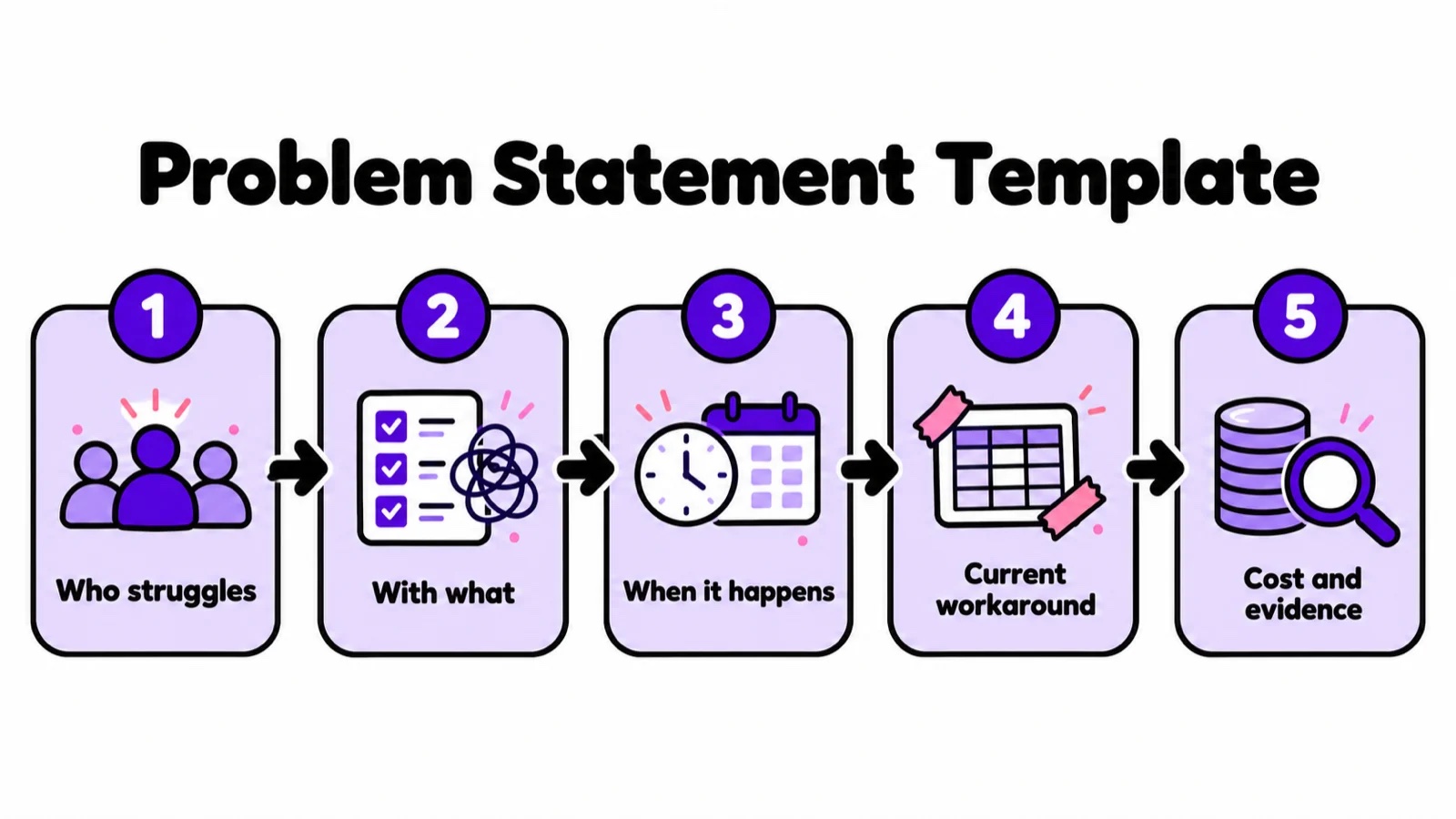
The 5 parts of a problem statement for a startup
- Who: a customer group narrow enough that you could find 20 of them this week.
- What: the task or goal they struggle with, described in their words.
- When: the situation or trigger that makes the problem show up.
- Workaround: what they do today (a spreadsheet, a freelancer, a competitor, or nothing at all).
- Cost and proof: the time, money, stress or risk it creates, and how you know.
Problem statement, mission statement and pitch line: what is the difference?
These statements get mixed up in pitch decks and school assignments all the time. Here is how they differ, using one imaginary allergy startup plus one in-company sample:
| Statement | What it answers | Sample |
|---|---|---|
| Startup problem statement | Who struggles with what, and why current options fail | Parents of children with food allergies spend 20 minutes per shopping trip reading labels, because one missed ingredient can end in the emergency room. |
| Pitch line (one-liner) | What you do and for whom | An app that checks any grocery label against your family’s allergy list. |
| Mission statement | Why the company exists in the long run | Make food shopping safe and fast for every allergy family. |
| Business problem statement | The gap between current and target performance inside a company | Wrong-item shipments rose from 1.5% to 4% of orders after the warehouse move. |
The figures in these samples are invented to show the format. Your real statement uses numbers you collected yourself.
Startup problem statement template
Copy this fill-in template, replace every bracket, and you have a first draft in ten minutes:
[Specific customer group] struggles to [task or goal] when [situation or trigger]. Today they [current workaround], which costs them [time, money, risk or stress]. We know this because [evidence: interviews, data, reviews].
For a slide or a hackathon form, use the short version that Google’s design-thinking guide for developers recommends: USER_GROUP needs NEED because REASON. The same Google for Developers page warns against writing the need as a solution: “needs an app to order food” is a product idea, while “needs to access nutritious meals quickly” is the actual need.
How to fill in each slot
| Slot | Question to ask yourself | Filled-in sample |
|---|---|---|
| Customer group | Who exactly? Could I find 20 of them this week? | Freelance bookkeepers with 10 to 30 small-business clients |
| Task or goal | What are they trying to get done? | Collect every client receipt before the quarterly VAT deadline |
| Situation | When does it hurt most? | The last week of every quarter |
| Workaround | What do they do today instead? | Chase clients by email and WhatsApp, then retype photographed receipts into a spreadsheet |
| Cost | What does the workaround cost them? | Lost evenings and weekends, plus late-filing fines for their clients |
| Evidence | How do I know this is true? | 15 interviews, time logs from 3 bookkeepers, threads in bookkeeping forums |
Put together: Freelance bookkeepers with 10 to 30 small-business clients struggle to collect receipts before each quarterly VAT deadline. In the last week of every quarter they chase clients by email and WhatsApp and retype photos into spreadsheets, which eats their evenings and exposes clients to late-filing fines. The evidence goes in bullets under the statement on your slide, or in the appendix of your plan.
If you think better in boxes than in sentences, fill in the problem statement canvas first and turn each box into one clause of the template.
4 rules that keep the template honest
- Leave the solution out. If the statement contains “app”, “platform” or your product name, rewrite it.
- One customer group per statement. Two groups means two statements, so a marketplace writes one for buyers and one for sellers.
- Use their words. Customers say “I lose my Sundays to scheduling”, and that line beats any jargon you could write.
- Add a number as soon as you have one. “9 of 14 bookkeepers we interviewed” is stronger than “many bookkeepers”.
Startup problem statement examples by industry
Here are 12 startup problem statement examples you can adapt. Each one is a hypothesis, so the last column tells you which evidence turns it from a hunch into a fact before you show it to an investor.
| Industry | Problem statement | Who has the problem | Evidence to collect |
|---|---|---|---|
| EdTech | First-year students with part-time jobs fall behind in math-heavy courses because tutoring hours clash with their shifts and recorded lectures can’t answer their questions. | Working first-year students in STEM programs | 15 student interviews, tutoring center hours compared with shift patterns, course drop-out figures from the faculty |
| FemTech and health | Women in perimenopause leave a 10-minute doctor’s visit without a plan for symptoms that wreck their sleep and work, then wait for a specialist appointment. | Working women aged about 40 to 55 | Symptom diaries, local specialist waiting times, interviews about what they tried before seeing a doctor |
| FinTech | Freelancers with irregular income can’t tell how much tax to set aside each month, so one tax bill can wipe out their savings. | Self-employed creatives and consultants in their first 3 years | Interviews, anonymized bank statements from 5 freelancers, tax office data on payment plans, forum threads |
| Food and beverage | Small bakeries throw away unsold bread every evening because they bake to a guess and have no quick way to sell leftovers before closing. | Owners of independent bakeries | Two-week waste logs from 5 bakeries, what happens to leftovers today, the fee they would accept per sale |
| E-commerce | Independent clothing shops lose online sales because customers can’t tell how a size fits, and every return eats the margin on that order. | Owners of small online fashion stores | Return rates and return reasons from their shop admin, cost per return, reviews that mention fit |
| SaaS for small business | Owners of 5 to 20 person service businesses build next week’s staff schedule by hand on Sunday evenings, then rebuild it when someone calls in sick. | Owners of salons, cafés and cleaning companies | Time logs, screenshots of current schedules (spreadsheets, WhatsApp groups), number of schedule changes per week |
| HR and recruiting | Hiring managers at 50 to 200 person companies lose strong candidates because interview feedback from busy colleagues takes more than a week to collect. | Hiring managers and in-house recruiters | Time from interview to decision in their hiring software, candidate withdrawal reasons, interviews |
| Travel and hospitality | Families traveling with a wheelchair user can’t confirm a hotel room is truly step-free until they arrive, so they rebook the same few hotels or stay home. | Families with a member who uses a wheelchair | Interviews, a review of 50 hotel listings for accessibility detail, complaints in guest reviews |
| PropTech | First-time renters in big cities sign leases without any way to check a landlord’s history, and find out about repair or deposit problems after moving in. | Renters aged 20 to 30 signing their first lease | Deposit dispute figures from tenant unions or deposit schemes, interviews, rental forum posts |
| Climate and energy | Homeowners who want a heat pump give up after collecting quotes that differ wildly in price and use technical terms they can’t compare. | Owners of older houses considering a heat pump | Real quotes from 10 homeowners, the step where they stopped, installer interviews |
| Engineering and manufacturing | Small product design studios lose track of who holds which version of their CAD files once designs go to suppliers, and can’t prove ownership if a design leaks. | Owners and lead engineers of design studios that work with outside manufacturers | File versions shared per project, past disputes, current NDA habits, interviews |
| Care and family | Adult children who manage a parent’s care from another city learn about missed medication or appointments days later, through a worried phone call. | Working adults caring for an aging parent remotely | Two-week diary study, number of people and apps involved in the care loop, interviews |
Problem statement for startup ideas you haven’t built yet
When all you have is an idea, write the problem statement before you name the idea. Start from your concept, ask “what has to be true for someone to pay for this?”, and turn the answer into a sentence about a person. Say your idea is an app that plans dinners from whatever is in the fridge. The problem statement behind it: working parents throw away food they bought with good intentions, because by 7 pm nobody has the energy to plan a meal around it. Now you can test the problem without writing a line of code.
Problem statements for student projects and hackathons
Teachers and hackathon juries look for three things: one specific group, no solution hidden in the sentence, and at least one cited data point. If you still need a topic, pick one from our list of business project ideas and run it through the template above.
How did unicorn startups frame their problem statement?
Unicorn startups wrote problem statements that named a real group of people, a workaround those people already used and the reason existing options failed. The word “unicorn” comes from investor Aileen Lee, who used it in a 2013 TechCrunch article for US software startups founded since 2003 and valued at $1 billion or more. Here are four whose early problem framing you can check in the founders’ own documents or interviews.
Airbnb: hotels cost too much and keep you away from the city (2008 pitch deck)
The first Airbnb deck, from when the company was still called AirBed&Breakfast, opened with three short problem lines, as Business Insider reported:
- Price is an important concern for customers booking travel online.
- Hotels leave you disconnected from the city and its culture.
- No easy way exists to book a room with a local or become a host.
Why it works: one line covers price, one covers the experience and one covers the missing marketplace, for guests and hosts at once. The deck also pointed to people already living with a workaround: Couchsurfing.com had 630,000 users at the time, yet there was no easy, central platform that worked around the world. Business Insider put Airbnb’s later private valuation at $31 billion.
Dropbox: “no good integrated solution” (2007 Y Combinator application)
Drew Houston’s original Y Combinator application lists what small teams need: their files wherever they are, everyone working on the latest version, and data protected from disaster. Then it names the substitutes people used (separate sync tools, backup tools and web upload tools) and concludes there was “no good integrated solution”. He adds a human proof point: his little sister used the beta for her high school papers and no longer burned CDs or carried USB sticks.
What to copy: name the workarounds. Investors trust a problem more when they can see what people do today and why it is clumsy. Dropbox reached a $10 billion valuation in 2014, TechCrunch reported.
Canva: a whole semester to learn where the buttons are (Melanie Perkins)
Melanie Perkins was 19 and teaching other university students in Perth to use design programs in 2006 when she spotted the problem, she told CNBC Make It. Students found the software “crazy hard”, and people spent “an entire semester learning where the buttons were”. She and Cliff Obrecht first tested the idea in a narrow niche, an online school yearbook design business called Fusion Books, and started Canva in 2013. CNBC reported a $3.2 billion valuation after an October 2019 funding round.
The takeaway: the cost was time to learn, measured in semesters. A clear unit of pain (hours, semesters, euros) makes a problem statement stick in an investor’s head.
Rent the Runway: a closet full of clothes and nothing to wear
In 2008, Jennifer Hyman watched her younger sister Becky buy a $1,600 Marchesa dress for a wedding, even though her closet was full. Becky had already been photographed in every dress she owned and couldn’t stand repeating an outfit. Fortune’s account of the founding sums up the problem as “a closetful of dresses, but nothing to wear”. When Hyman asked why she picked such an expensive dress, Becky said she wanted to feel beautiful. Hyman took the story to Jennifer Fleiss, they founded Rent the Runway, and the company reached a $1 billion valuation in March 2019, Fortune reported.
Steal this: dig under the purchase. Becky’s real need was feeling confident in photos, and the new dress was her expensive workaround.
What these four problem statements have in common
| Startup | Who had the problem | Workaround people used | Where the framing comes from |
|---|---|---|---|
| Airbnb | Budget travelers, and locals with spare space | Hotels, Couchsurfing | Founders’ 2008 pitch deck (via Business Insider) |
| Dropbox | Small teams and everyday computer users | Email, USB sticks, burned CDs, separate sync and backup tools | Founder’s 2007 Y Combinator application |
| Canva | Students and non-designers | Months of learning professional design software | Founder interview, CNBC Make It, 2020 |
| Rent the Runway | Women with an event to dress for | Buying an expensive dress for one occasion | Founders’ account, Fortune, 2013 |
All four start with a person in a specific moment, and the billion-dollar valuations arrived years after those first sentences were written. For more company stories with the lessons spelled out, read our startup business examples.
Business problem statement examples for established companies
A business problem statement describes the gap between how a process performs today and how it should perform, plus what that gap costs the company. Teams use it to kick off an improvement project, a business case or a consulting brief, and like a startup problem statement, it leaves the fix for later.
Fill-in format: Over [time period], [process or metric] moved from [X] to [Y], against a target of [Z]. This costs us [money, customers, hours or risk] every [month or quarter].
The numbers in brackets below are placeholders that show the format. Swap in the figures from your own systems.
| Area | Business problem statement example | Data to pull |
|---|---|---|
| Customer support | Over the last two quarters, the average first reply to support emails grew from [6] to [30] hours, against a target of [8]. Customers who wait more than a day cancel at [twice] the rate of others. | Help desk reports, cancellations by wait time |
| Sales | [40%] of qualified leads from trade fairs get no follow-up call within a week, so deals we paid [€X] per fair to start go cold. | CRM export, trade fair costs |
| Warehouse | Since the move to the new warehouse in [March], wrong-item shipments rose from [1.5%] to [4%] of orders, and each one costs [€25] in returns and reshipping. | Order error logs, return costs |
| HR | [1 in 3] new customer service hires leave within 90 days, and replacing each one costs about [two months] of salary in recruiting and training time. | HR system exit dates, exit interviews |
| Finance | Invoices go out an average of [14] days after a project closes, which pushes [€X] of cash into the next month and forces us to draw on our credit line. | Invoice timestamps, bank statements |
| Marketing | Our newsletter list doubled in a year, but sales from email stayed flat at [€X] per month, so we pay more for the email tool without more income. | Email platform stats, sales by channel |
| IT | Staff open [120] password-reset tickets a month and each takes [15] minutes, which adds up to [30] hours of IT time on one repeat task. | Ticket categories in the help desk system |
| Manufacturing | Scrap on line [2] rose to [6%] of output after the supplier change, against [2%] on the other lines. | Production logs, supplier batch numbers |
Business plan problem statement examples
In a business plan or business proposal, the problem section answers three questions in about half a page: who has the problem, how big it is in money or numbers, and why current options fail. Here is a sample with placeholders: Independent physiotherapy clinics in [region] ([number] clinics, source: [registry]) lose [X] hours a week to missed appointments. Reminder tools built for hospitals cost [€X] per month and need IT support these clinics don’t have.
Size claims belong in this section, so back them with a bottom-up estimate. Our guide on how to calculate TAM SAM SOM for a startup walks you through it.
Business research problem statement example
Academic and market research projects phrase the problem as a gap in knowledge: Small grocery stores in [city] that added self-checkout report mixed results, and nobody has measured which store traits predict whether the investment pays back. The research question follows from it: which store traits predict a payback within [24] months?
Weak and strong problem statements side by side
A weak problem statement describes a market, a trend or a product. A strong one describes a person, a moment and a cost you can check. Seven rewrites (the strong versions are sample hypotheses that show the shape, so test them before you borrow one):
| Weak | Strong | What changed |
|---|---|---|
| People need a better way to manage money. | Freelancers with irregular income can’t tell how much tax to set aside each month, so one tax bill can wipe out their savings. | A named group, a concrete moment, a cost |
| There is no good app for finding tutors. | Parents of teens with dyslexia spend weeks searching for a tutor trained in their child’s needs and pay for trial lessons that don’t work out. | The hidden solution (“app”) is gone |
| Small businesses struggle with marketing. | Owners of single-location restaurants post on Instagram when they find time and can’t tell which posts fill tables on slow weeknights. | One segment, one measurable outcome |
| Healthcare is broken. | Night-shift nurses hand over patients with handwritten notes, and details get lost between shifts. | An opinion became observable behavior |
| Our AI platform helps HR teams work smarter. | Recruiters at 50 to 200 person companies spend [X] hours a week rescheduling interviews by email. | Product name and buzzwords removed |
| Millennials want sustainable fashion. | Women aged 25 to 35 who want to buy secondhand give up because sizes differ across resale sites and they can’t return an item that doesn’t fit. | A trend became a barrier you can test |
| Everyone hates commuting. | Parents who commute more than an hour each way miss daycare pickup when trains run late and pay a late fee each time. | “Everyone” became someone |
5 mistakes that weaken a startup problem statement
- The solution in disguise. “There’s no app for X” describes your product idea, and customers never describe their lives that way.
- Everyone as the customer. If you can’t name where to find the first 20 people, the group is too wide.
- Trends instead of behavior. “Gen Z cares about the planet” tells you nothing about what a 22-year-old does on a Tuesday, and Tuesday behavior is where problems live.
- Symptoms instead of causes. Customers say “it’s slow”. Ask why until you reach the cause you could fix.
- No evidence. Swap “everyone says so” for counts like “9 of 14 interviewees described this in the last month”.
How do you test a problem statement with customers?
Test a problem statement by talking to 10 to 20 people from your customer group about the last time they had the problem, without pitching your idea, and by checking whether they already spend time or money on a workaround. If most of them can’t recall a recent, specific moment, rewrite the statement before you build anything.
Step 1: Turn the statement into 3 assumptions
- The group exists and you can reach it. You know where they gather, online and offline.
- The problem comes back regularly. Weekly or monthly beats once a year.
- They care enough to act. They already pay, hack or complain about it.
Step 2: Interview without pitching
At Y Combinator’s Startup School, Pebble founder Eric Migicovsky recommended five interview questions, summarized on the YC blog. Adapted to your problem statement:
- What is the hardest part about [the task in your statement]?
- Tell me about the last time you ran into this problem.
- Why was that hard?
- What, if anything, have you done to solve it?
- What don’t you love about the solutions you’ve already tried?
The same talk names three mistakes: pitching your idea, asking hypothetical questions and talking too much. Rob Fitzpatrick’s book The Mom Test builds on the same idea, and its three rules, as Unusual Ventures summarizes them, are: talk about the customer’s life instead of your idea, ask about specifics from the past, and talk less while listening more.
Step 3: Rate what you hear
| What you hear | What it means | Next step |
|---|---|---|
| They describe the last time step by step, with dates, people and tools | The problem is real for them | Ask what it cost them in time or money |
| They built a workaround (a spreadsheet, hired help, a paid tool) | They already spend time or money on it | Strong signal: write down what they pay |
| They ask when they can try your fix or offer to pay upfront | Urgency | Offer a pilot or a pre-order |
| They say “great idea” but can’t recall a recent example | Politeness | Count it as no data |
| Only hypothetical answers (“I would probably use…”) | An opinion about the future | Rewrite your questions around past events |
| The problem is real but belongs to someone else (a boss, a parent) | Wrong customer | Rewrite the “who” in your statement |

Step 4: Rewrite, then retest
Put your counts into the evidence line (“11 of 16 bookkeepers retype receipts by hand every quarter”) and sharpen the “who” around the people who reacted most. List every alternative interviewees mention, then use our AI competitive market analysis tool to plan how you will size up those competitors. Once the problem holds up, move it into the customer segment box using these business model canvas ideas.
Elona Musk, our AI co-founder, will happily draft ten versions of your statement in a minute. Only your customers can tell you which one is true. If you want to practice this whole loop with deadlines and a community of women founders around you, the Fe/male Switch startup game takes you from idea to first customer through practical quests.
FAQ about startup problem statements
What is a good problem statement for a startup?
A good startup problem statement names a specific customer group, the situation where the problem shows up, what it costs them and what they do today, in one to three sentences. It has evidence behind it and no solution inside it.
How long should a startup problem statement be?
One to three sentences, about 50 words at most, so it fits on one pitch deck slide. Put the supporting evidence in bullets below it or in the appendix of your business plan.
Should a problem statement include the solution?
No. Keep your product out of it so you can test the problem on its own, and so readers judge the problem before they judge your idea.
What is a unicorn problem statement?
People use the phrase for the problem statements of unicorn startups, meaning young companies valued at $1 billion or more. The documented ones above (Airbnb, Dropbox, Canva, Rent the Runway) each name a real group, a workaround and a cost.
What is the difference between a business problem statement and a startup problem statement?
A business problem statement describes a gap inside an existing company, between current and target performance of a known process. A startup problem statement describes a customer group’s problem in a market you haven’t proven yet, so it needs customer evidence first.
How do I write a problem statement for an entrepreneurship assignment?
Use the template above, pick one customer group, add two or three data points from sources you cite (government statistics, industry reports, your own interviews), and save your solution for the next section of the assignment.
Where do I find data for a problem statement?
National statistics offices, industry associations, academic papers on Google Scholar, annual reports of public companies, app store and product reviews (for the customer’s own words) and, most convincing of all, your own interviews and time logs.
What is a challenge statement?
In design thinking workshops and idea competitions, a challenge statement turns the problem into an open question that starts with “How can we…”. Problem: night-shift nurses lose details at handover. Challenge statement: how can we make sure no patient detail gets lost between shifts?
Can ChatGPT write my startup problem statement?
An AI assistant can draft and tighten the wording, but it can’t supply evidence. Write the draft with AI if you like, then test it in customer interviews and replace every guess with something you heard or measured.
Keep learning
- Problem statement canvas: map who has the problem and why before you write a word.
- How to calculate TAM SAM SOM: size the market behind your problem.
- Startup business examples: successful startups and what they teach.
- Startup stories: how founders got through the first hard years.
- Business project ideas: topics for students and teams that need a problem to solve.
- First startup checklist on the Fe/male Switch blog: plan the next steps once your problem statement holds up.
- Fe/male Switch startup game: build your startup from idea to first customer.
Authors
Mean CEO | Violetta Bonenkamp AUTHOR
MeanCEO (aka Violetta Bonenkamp) is a serial startup founder who brings a decade of entrepreneurial experience to the table. Armed with five Higher Education degrees (including an MBA) and profound knowledge in sectors like blockchain, AI, zero code and education she is a maestro in turning ideas into validated businesses, building prototypes in a few hours and devising marketing strategies for tech startups that increase founder's chances of success. Recognized as one of the top 100 women in EU startups, her guidance is a treasure trove for upcoming and established entrepreneurs alike. Through her venture into entrepreneurship, she has created the "gamepreneurship" methodology, an innovative method for learning business through gameplay.

Elona Musk
Elona Musk stands as a mix of innovation and expertise in the realm of AI, serving as the Chief AI Officer at Fe/male Switch. As an embodiment of the startup game for women, Elona is the co-founder you dream of - knowledgeable, always active, capable of keeping trade secrets to herself and equity-free. With her hands-on approach in entrepreneurship simulation, she provides vital strategies and insights that are essential for navigating the complex startup journey and saves entrepreneurs hours of work by automating many tasks, starting from market research to managing social media to writing business plans. Whether it's a marketing strategy for tech startups that you need or a solid IP strategy, Elona's AI-driven insights help carve successful paths for entrepreneurs who don't have technical or startup skills.
Who we are
We are experienced and fun entrepreneurs and awesome AI PlayPals who love building a startup simulator for you to succeed in business

Violetta Bonenkamp
Business and AI expert

Dirk-Jan Bonenkamp
Legal, IP and finance expert
Elona Musk
The first AI entrepreneur

Petra Thiel
The first AI startup investor

Samantha Altman
The first AI startup mentor

Sia Quick
AI Market Research expert
Unleash your inner founder with AI Startup Tools!
Don't just dream it, build it with our range of AI startup tools. From brainstorming ideas to naming your product and crafting a unique logo, these AI tools are your secret weapon to conquer the startup world.
 Newest
Boost Your SEO Game
Generate a customized SEO strategy for your small business agency by answering a simple question. Our tool focuses on free and easy…
 27
19
5/5
Newest
Positioning Pro - Your Strategic Partner
Positioning Pro helps bootstrapped entrepreneurs discover effective segmentation and targeting strategies without spending money. Get tailored insights simply by answering one question.
13
6
5/5
Newest
Gated Content Strategy Tool
This tool provides actionable strategies for bootstrapped entrepreneurs, leveraging free and easy methods to kickstart your journey.
25
18
5/5
Recommended for you

Venmo Small Business Grant: Amounts, Rules and Next Round
Every Venmo Small Business Grant round checked against Venmo's and PayPal's own pages: amounts, winners, eligibility, judging, status and open alternatives.
Read more
Small Business Grants for Women in Texas: Amounts and Dates
Texas grants for women-owned businesses checked on official pages: TWU StartUP and Rural grants, Amber Grant, state and city programs, rules and deadlines.
Read more
Your First Cold Campaign: A Deliverability Guide for Founders
First cold email campaign? Set up a separate sending domain, SPF, DKIM and DMARC, warm up, clean your list and run this pre-send checklist before you hit send.
Read more