13 Startup Business Examples: How Successful Startups Began
TL;DR
The best startup business examples, from Airbnb and Stripe to Canva and Spanx, won their first customers by hand: a campus pop-up, 20 friends, a website built in one afternoon. Below are 13 sourced startup examples by industry, six founded or co-founded by women, plus a step-by-step walkthrough from idea to first customers that you can rehearse in our startup game.
 Mean CEO | Violetta Bonenkamp
13/09/2024 - 19 mins read
Join the F/MS Startup Game now
Access all AI tools, advanced features & more!

Harness our free AI tools for building your startup.

Get a customized live roadmap for your startup.

Join our Community and connect with entrepreneurs.
The classic example of a start up business is Airbnb: it began in 2007 when two hosts welcomed three guests to their San Francisco home, and by May 2026 it counted more than 5.5 million hosts (Airbnb newsroom). Stripe, Canva, DoorDash and Spanx are other startup examples worth studying, because each one won its first customers with a scrappy, documented move you can copy this month.
I’m Violetta Bonenkamp, the Mean CEO behind Fe/male Switch and CADChain. Most lists of successful startups stop at the valuation; this one starts with how the FIRST customers showed up, because that is the part you can copy on day one. You get 13 startup business examples by industry, six of them founded or co-founded by women, each with the founding year, the first-customer story and the lesson, with every fact linked to its source. Elona Musk, our AI co-founder, helped me keep the dates straight.
Let’s break it down: a definition first, then the big table, then the women-led companies, the patterns they share, small startup examples, and a walkthrough from idea to first customers.
What is a startup business?
A startup business is a young company built to grow fast by selling a repeatable product to a large market. Paul Graham, co-founder of the accelerator Y Combinator, put it in one line: “A startup is a company designed to grow fast” (Startup = Growth, 2012).
Being new does not make a company a startup. In the same essay Graham compares a startup with a barbershop: the barbershop can only serve as many customers as it can physically handle, while a startup makes something it can sell to a huge market. That is the cleanest answer to the “startup company meaning” question, and it explains why a new bakery and a young Canva both count as new businesses, yet only one was designed for explosive growth.
Startup vs small business: what is the difference?
| Question | Startup | Small business |
|---|---|---|
| Goal | Grow fast and reach a large market | Steady profit in a defined local or niche market |
| Product | Repeatable, can serve many customers at once (software, a new model, a product brand) | A service or familiar product with limited reach |
| Money | Founder savings, revenue, angel investors or venture capital | Savings, bank loans, revenue |
| Risk | High, many experiments fail | Lower, the model is proven |
| Growth benchmark | 5 to 7% a week counts as good during Y Combinator (Paul Graham) | Monthly profit and repeat customers |
| Examples | Stripe, Canva, Bumble | A hair salon, a bakery, a bookkeeping firm |
How many new businesses survive?
Survival is the first filter for any startup business. The US Bureau of Labor Statistics followed private-sector business establishments born in March 2013: 79.6% were still open after one year, 50.6% after five years and 34.7% after ten (BLS, January 2024). Those numbers cover every kind of new business, from cafes to software companies. The startups below beat those odds, and their early moves explain how.
Startup examples by industry: 13 successful startups and how they got their first customers
Here are 13 startup examples by industry, each with the founding year, what the company does, how it won its first customers and the lesson I take from it. Companies marked ★ were founded or co-founded by women; they get their own deep-dive section further down.
| Industry | Startup and founders | Founded | What it does | How it got its first customers | Lesson |
|---|---|---|---|---|---|
| Travel and hospitality | Airbnb: Brian Chesky, Joe Gebbia, Nathan Blecharczyk | 2008 (first guests 2007) | Marketplace for short-term stays | Launched at SXSW in March 2008 with two bookings (Airbnb), then went door to door in New York to recruit hosts (Paul Graham) | A slow launch is data; fix supply by hand |
| Fintech and payments | Stripe: Patrick and John Collison | 2009 | Online payments infrastructure | Set up new users on their own laptops on the spot, the “Collison installation” (Paul Graham) | Remove every step between “yes” and “using it” |
| Food delivery and logistics | DoorDash: Tony Xu, Andy Fang, Stanley Tang, Evan Moore | 2013 | Local delivery from restaurants and stores | Built a one-page site in an afternoon and delivered a couple hundred orders themselves (Stanford Daily) | Interview first, automate later |
| Workplace software | Slack: Stewart Butterfield and co-founders | 2013 (preview) | Team messaging | Talked friends at 6 to 10 other companies into trying it (First Round Review) | Add teams in batches, fix, repeat |
| Consumer software | Dropbox: Drew Houston, Arash Ferdowsi | 2007 | File sync and storage | A demo video on Digg brought 75,000 wait-list signups in 24 hours (TechCrunch) | Show the product before it is ready for everyone |
| Edtech | Duolingo: Luis von Ahn, Severin Hacker | 2011 (beta) | Language learning app | Beta with 100,000+ users and a waiting list of about 500,000 (Carnegie Mellon) | Your first business model is a guess |
| Marketing software | Mailchimp: Ben Chestnut, Dan Kurzius | 2001 | Email marketing for small businesses | Built as a side project inside their web design agency (Mailchimp) | A side project with paying customers can fund itself |
| Design software | Canva ★: Melanie Perkins, Cliff Obrecht, Cameron Adams | 2013 | Online design platform | Tested the idea first with Fusion Books, an online school yearbook business (CNBC) | Prove the idea in one small niche |
| Apparel and consumer goods | Spanx ★: Sara Blakely | 2000 | Shapewear and apparel | Cold calls, then a before-and-after demo for a Neiman Marcus buyer (NPR) | Show the result live |
| Dating and social apps | Bumble ★: Whitney Wolfe Herd | 2014 | Dating app where women make the first move | Cookies for sororities and pizza for fraternities on college campuses (CNBC) | Launch where both sides of your market meet |
| Beauty, direct to consumer | Glossier ★: Emily Weiss | 2014 | Skincare and makeup brand | Grew out of the beauty website and community Into The Gloss (Glossier) | Build the audience before the product |
| Fashion rental | Rent the Runway ★: Jennifer Hyman, Jennifer Fleiss | 2009 | Designer clothing rental and subscription | A pop-up shop on Harvard’s campus where students rented dresses on the spot (Rent the Runway) | Test a new habit with a pop-up |
| Online personal styling | Stitch Fix ★: Katrina Lake (with Erin Morrison Flynn) | 2011 | Personal styling service that ships clothes to try at home | Picked clothes for 20 friends as an experiment in 2010 (NPR) | Be the algorithm by hand before you build one |
Airbnb: travel and hospitality (2008)
Airbnb says it was born in 2007, when two hosts welcomed three guests to their San Francisco home, and that Airbed & Breakfast officially launched at SXSW in March 2008 with just two bookings (Airbnb newsroom). Two bookings, at a festival packed with travelers. Later the founders went door to door in New York, recruiting new users and helping existing hosts improve their listings, as Paul Graham describes in Do Things That Don’t Scale.
Lesson: a weak launch is information. Airbnb fixed its supply side listing by listing, and today counts more than 5.5 million hosts (May 2026).
Stripe: fintech and online payments (2009)
Brothers Patrick and John Collison founded Stripe in 2009, according to its Y Combinator profile. Their first-customer trick became famous enough to earn a name at Y Combinator: the “Collison installation”. When someone agreed to try Stripe, the brothers asked for the laptop and set the person up right there (Paul Graham).
Lesson: the gap between “sounds good” and “I’m using it” is where early sales die, so close it yourself. Businesses on Stripe processed more than $1.4 trillion in payments in 2024 (Stripe newsroom).
DoorDash: food delivery and logistics (2013)
DoorDash grew out of Stanford. Tony Xu, Andy Fang and Stanley Tang are listed as founders on its Y Combinator profile, and the Stanford Daily names Evan Moore as a cofounder too. They interviewed more than 100 small business owners, then built a one-page site called PaloAltoDelivery.com in a single afternoon and got their first online order right away.
Lesson: the founders delivered the first couple hundred orders themselves. The full step-by-step is in the early-stage example further down.
Slack: workplace software (2013)
Slack came out of a failure. Stewart Butterfield’s team started building the app at the end of 2012, after an attempt at a web-based multiplayer game, and by March 2013 they were using it themselves (First Round Review). In May 2013 they talked friends at other companies into trying it, which gave them six to ten teams, including Cozy and Rdio. The August 2013 preview drew 8,000 invitation requests on the first day and 15,000 two weeks later.
Lesson: add teams in growing batches and fix what breaks before you invite the next batch.
Dropbox: consumer software and file sync (2007)
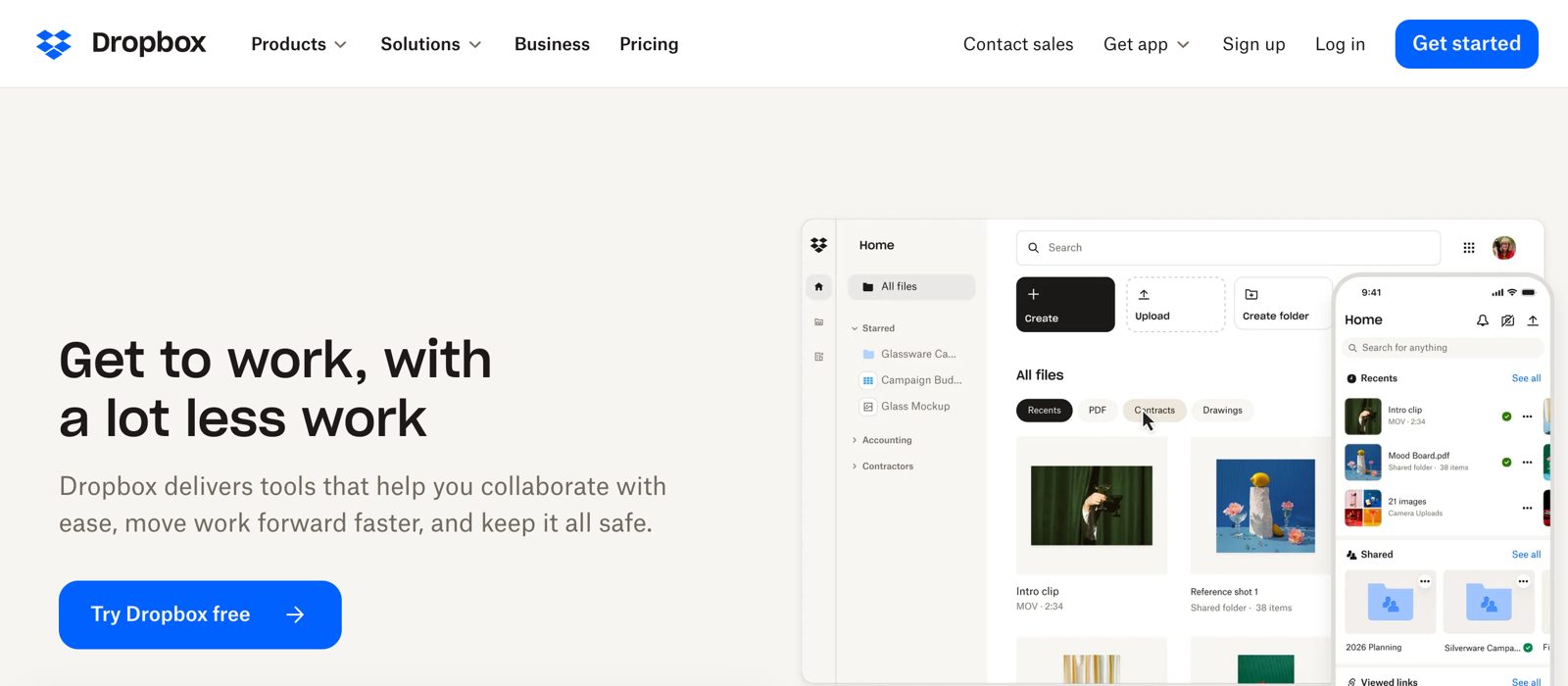
Drew Houston co-founded Dropbox in 2007 (Dropbox) with Arash Ferdowsi (Y Combinator profile). A first demo video caught Y Combinator’s attention. A year later a second video on Digg, full of Easter eggs aimed at Digg’s audience, brought 75,000 wait-list signups within 24 hours, against the 15,000 the team expected (TechCrunch). Dropbox then let people in gradually through a closed beta.
Lesson: a short video can prove demand before the product is ready for everyone, as long as it speaks the language of the crowd watching it.
Duolingo: edtech and language learning (2011)
Carnegie Mellon computer scientists Luis von Ahn and Severin Hacker created Duolingo. Its beta began in November 2011, more than 100,000 people used it during the test, and about 500,000 were on the waiting list when the beta ended (Carnegie Mellon University, June 2012). Back then the plan was to sell commercial translation services. Today Duolingo sells subscriptions: as of December 31, 2025, about 9% of its monthly active users were paid subscribers (Duolingo annual report).
Lesson: your first revenue model is a guess. Duolingo kept the product people loved and swapped the business model.
Mailchimp: marketing software (2001)
Ben Chestnut and Dan Kurzius ran a web design agency, the Rocket Science Group, that served big corporate clients. On the side they built an email marketing service for small businesses, and Mailchimp was founded in Atlanta in 2001 (Mailchimp). TechCrunch called it “famously bootstrapped” when Intuit agreed to buy it for $12 billion in 2021 (TechCrunch).
Lesson: a side project with paying customers can fund itself for years. Venture capital is one option among several.
Successful startups founded by women
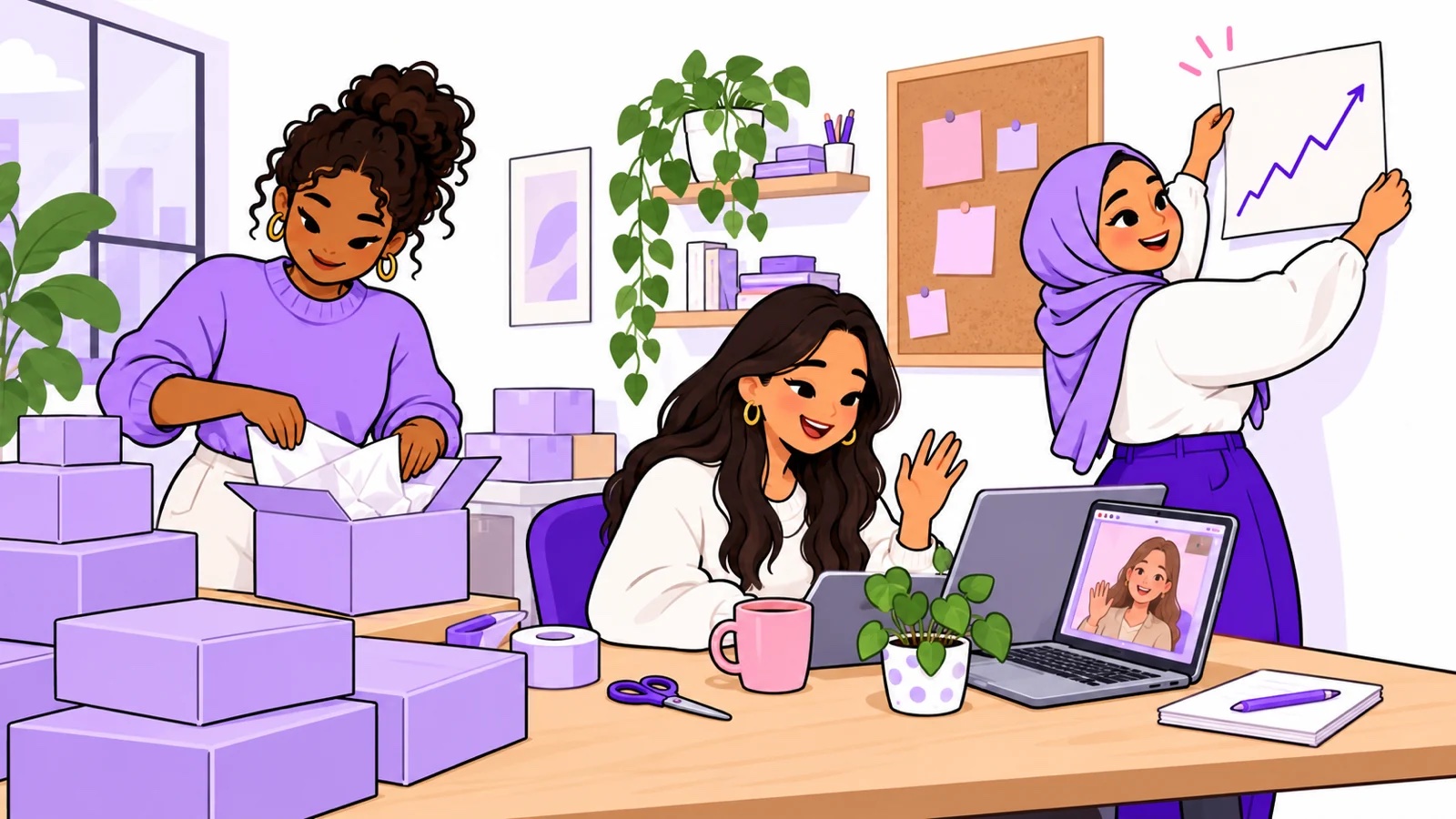
Six of the 13 startup business examples in this guide were founded or co-founded by women, and their first-customer stories are some of the most practical I know: a school yearbook business, a bathroom demo, a box of cookies, a beauty blog, a campus pop-up and 20 friends. At Fe/male Switch we build for women founders, so I gave these six their own section.
Canva: Melanie Perkins tested the idea on school yearbooks (2013)
Melanie Perkins was 19 and studying in Perth in 2006 when she saw how hard students found design software (CNBC). Before chasing the big vision, she and Cliff Obrecht started Fusion Books, an online yearbook design business, and printed and delivered the books to schools across Australia. Cameron Adams joined as tech co-founder, and the Canva site went live in 2013. In October 2019 an $85 million round valued Canva at $3.2 billion.
Lesson: prove your idea in one small niche before you go after everyone. Canva started in Australia, and by 2020 people in 190 countries had made close to 2 billion designs with it; if selling across borders is your plan too, browse our international business ideas.
Spanx: Sara Blakely won Neiman Marcus with a bathroom demo (2000)
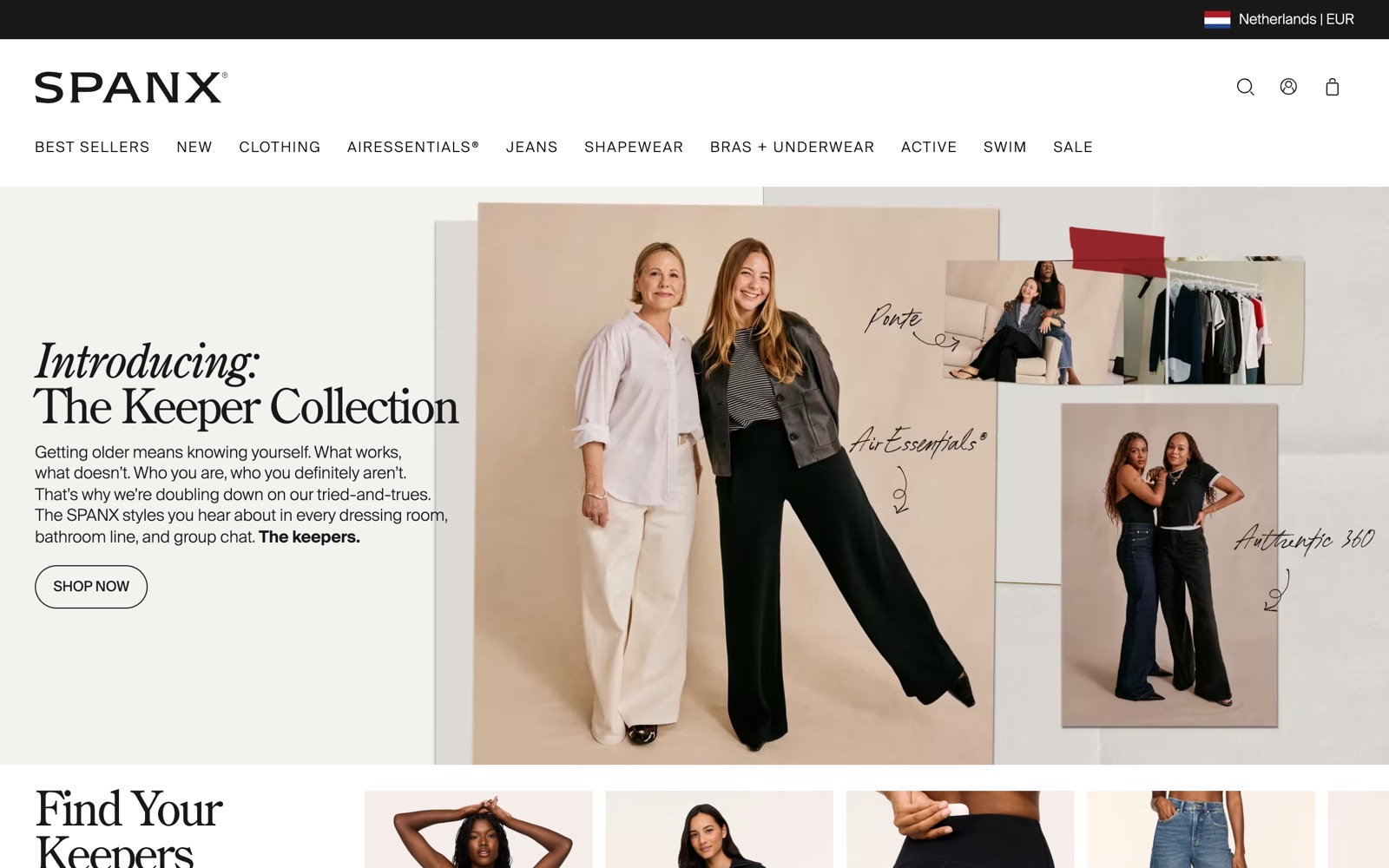
In 1998 Sara Blakely cut the feet off her control-top pantyhose to get a smooth look under white pants, and after two years of prototypes Spanx launched (Spanx). She was 27, selling fax machines, with no contacts in fashion or retail (NPR). After a long run of cold calls she got 10 minutes with a Neiman Marcus buyer in Dallas, felt the pitch slipping, and asked the buyer to come to the bathroom, where she showed her cream pants with and without Spanx (NPR transcript). The buyer got it on the spot. Once the product was in stores, Blakely paid friends to buy it so it would move off the shelves, and slipped Spanx near the cash registers.
Lesson: show the result live. And treat the first order as half the sale, because sell-through decides whether you get a second one.
Bumble: Whitney Wolfe Herd launched campus by campus (2014)
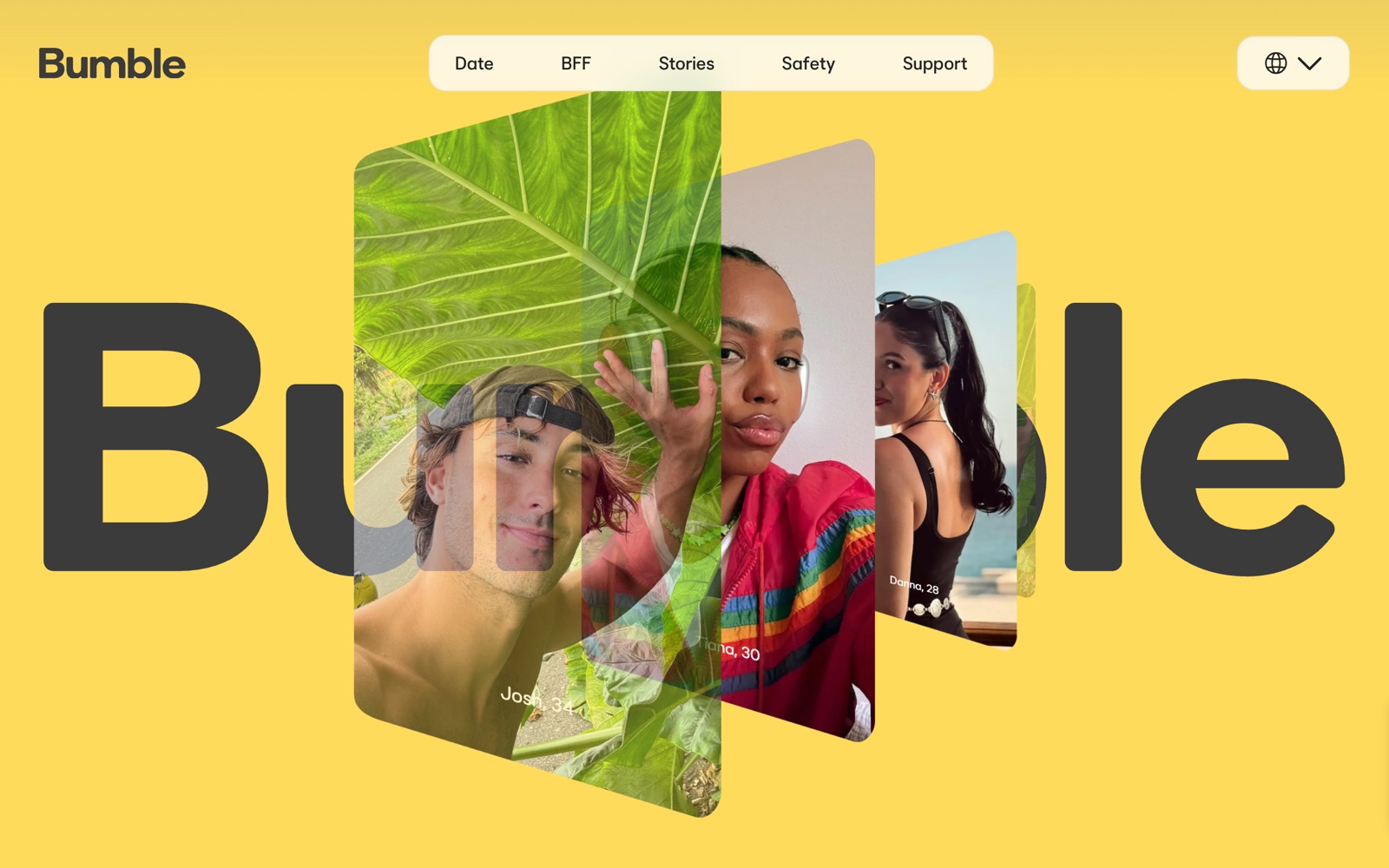
Bumble launched in December 2014 in Austin, Texas, on a modest budget (CNBC). Whitney Wolfe Herd paid a bakery $20 to put the Bumble logo on yellow cookies and took the box to a nearby sorority, then dropped off pizzas with bumblebee stickers at fraternities. Once members of both groups downloaded the app and started matching, the snowball began. Seven years after launch she became the youngest female founder to take a company public.
Lesson: a two-sided app needs both sides in the same place at the same time. A campus gives you that for the price of a box of cookies.
Glossier: Emily Weiss built the audience first (2014)
Emily Weiss ran Into The Gloss, a beauty website and community, before she launched Glossier in 2014 (Glossier; LS:N Global, October 2014). Glossier says the community is where it learned that beauty products should be shaped by the people who use them, so the brand started with readers and only then added products.
Lesson: content first, product second. A community that already asks you what to buy is the warmest first-customer list you will ever get.
Rent the Runway: Jennifer Hyman and Jennifer Fleiss ran a pop-up at Harvard (2009)
The idea came over Thanksgiving 2008, when Jenn Hyman’s younger sister showed off an expensive designer dress bought for a wedding (Rent the Runway). Hyman took the idea back to Harvard Business School and her friend Jenny Fleiss. They cold-emailed Diane von Furstenberg in December 2008, and in April 2009 they set up a pop-up shop on Harvard’s campus where students could try on and rent dresses on the spot. The website launched on November 10, 2009.
Lesson: a pop-up is the cheapest test of whether people will pay for a new habit. A loved product still needs sound economics: CNBC put Rent the Runway’s market value at roughly $120 million in July 2023, with shares under $2 against a $21 IPO price (CNBC).
Stitch Fix: Katrina Lake styled 20 friends first (2011)
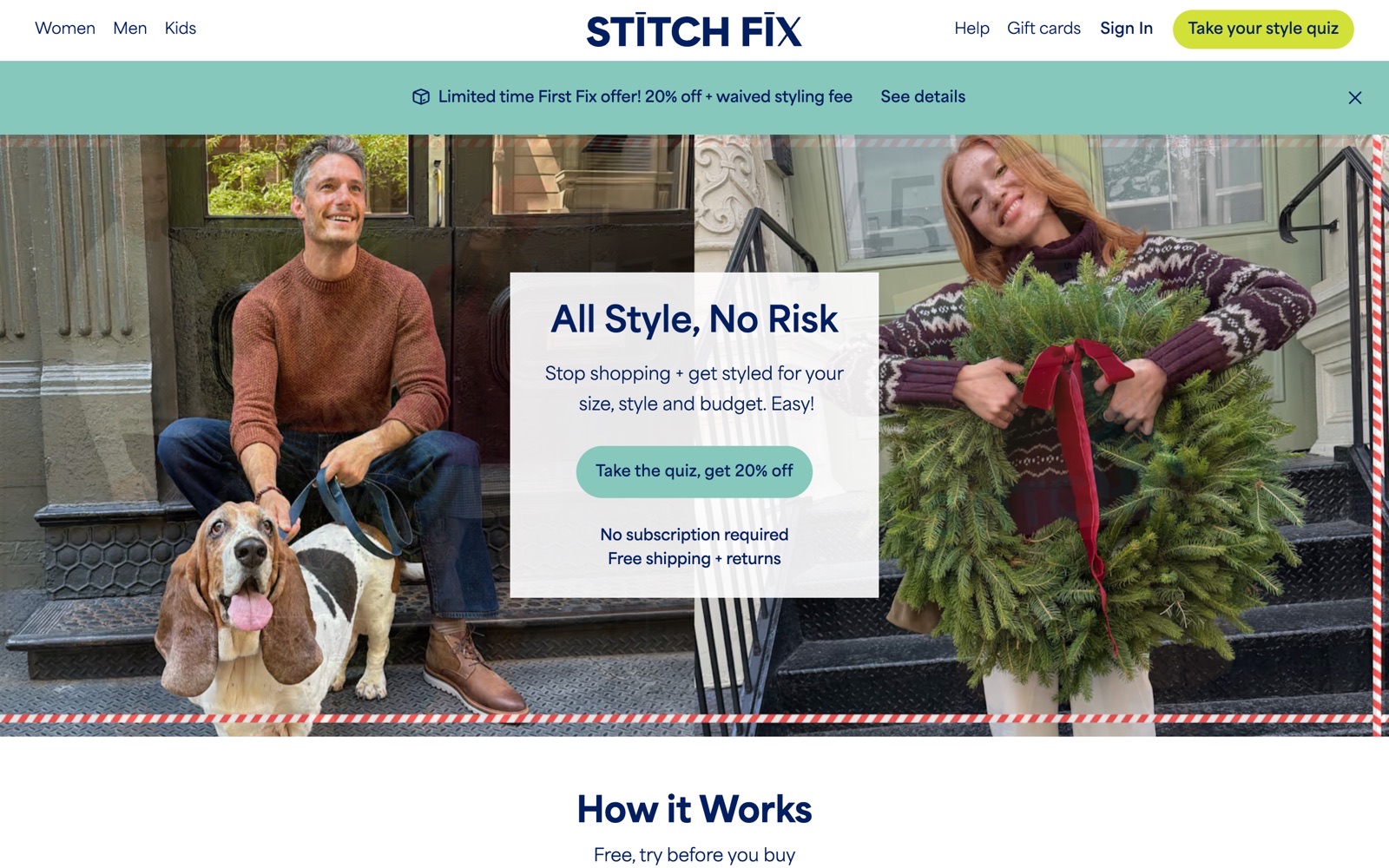
In 2010 Katrina Lake recruited 20 friends for an experiment, to see if she could pick clothes that matched each person’s style (NPR How I Built This). She ran the test from her apartment in Cambridge, Massachusetts, while studying at Harvard Business School, and the company officially launched in 2011 (Entrepreneur). Retail Dive, citing the Wall Street Journal, reports that Erin Morrison Flynn co-founded the company as well (Retail Dive). By 2018 NPR described Stitch Fix as having more than two million customers.
Lesson: be the algorithm by hand before you build one. Twenty people are enough to learn whether your picks land.
What do successful startups have in common?
Successful startups share three habits: they solve a problem the founders saw up close, they win their first customers BY HAND inside a community they can reach, and they keep enough cash to survive the slow start. The table below maps who did what.
Why do startups fail?
CB Insights studied 431 venture-backed startups that shut down since 2023. 70% ran out of capital, 43% had poor product-market fit (the market did not want the product enough), 29% hit bad timing and 19% had unit economics that did not work, meaning each sale cost more than it brought in (CB Insights, March 2026). CB Insights calls running out of capital the final cause of death; the root causes sit in the other three numbers. My read: every first-customer story in this guide is a cheap test of product-market fit run before the money ran out.
Six patterns from 13 startup examples
| Pattern | Startups that did it | Try this week |
|---|---|---|
| They saw the problem up close | Spanx, Rent the Runway, Canva, DoorDash | Write down 3 problems you or people around you already pay to fix |
| First customers came from a community they belonged to | Rent the Runway (Harvard), DoorDash (Stanford), Stitch Fix (20 friends), Slack (friends’ teams), Glossier (readers) | List 50 people in one community you can reach this week |
| They did work that doesn’t scale, by hand | Stripe, Airbnb, DoorDash, Spanx | Offer to set up, deliver or demo for your first 10 customers yourself |
| They tested before building everything | Rent the Runway (pop-up), Dropbox (video), Stitch Fix (experiment), Canva (Fusion Books) | Run one test that costs less than a weekend |
| They started narrow | Bumble (campuses), DoorDash (Palo Alto), Canva (yearbooks) | Pick one city, one campus or one niche |
| They watched the money | Mailchimp (bootstrapped), Rent the Runway (a warning) | Know how many months of cash you have left |
Rent the Runway, DoorDash and Bumble all used university campuses as their first market. If you are a student, your campus is a ready-made test market, and our guide to business ideas for students lists ideas sized for it. For longer narratives about setbacks and comebacks, read our startup stories.
Before you call your own idea a startup, check it against this list:
- You can name the person with the problem and what they pay to solve it today
- Ten of those people are reachable by you this month without ads
- A hand-made version of your product can be delivered next week
- Your cash runway covers at least the test period
Small startup business examples you can learn from
Small startup business examples are companies with a tiny team and budget that still sell something repeatable to a growing market. You will find plenty of them in the Fe/male Switch directory of real startups, where founders list their own companies. Here are five from the directory, with the cheapest first-customer move I would test for each, borrowed from the big names above.
| Type of small startup | Example from our directory | First-customer move to test |
|---|---|---|
| Local service with a tech layer | Pools Portugal: pool cleaning, maintenance and repairs for owners in Portugal’s coastal regions | Go door to door with holiday-rental owners and property managers, Airbnb style |
| Product brand with a material story | Greenwich Social Club: minimalist capsule eyewear made from deadstock luxury materials | Run a pop-up or trunk show, like Rent the Runway’s Harvard test |
| At-home health test | SwimScore: an at-home male fertility test with physician-reviewed results | Partner with clinics and coaches who already talk to the buyer |
| Niche content and review site | PaddlersPick: beginner pickleball gear reviews and buying guides | Answer beginner questions in local clubs and forums, then share the guides |
| Small software tool | Qria: customer feedback and review gathering with AI analysis | Install it for the first 10 customers yourself, Collison style |
Small can grow big. Mailchimp began as a side project of a web design agency and sold for $12 billion two decades later. If budget is your main constraint, our list of low start-up cost business ideas covers options you can launch with very little money.
An early-stage startup example, from idea to first customers
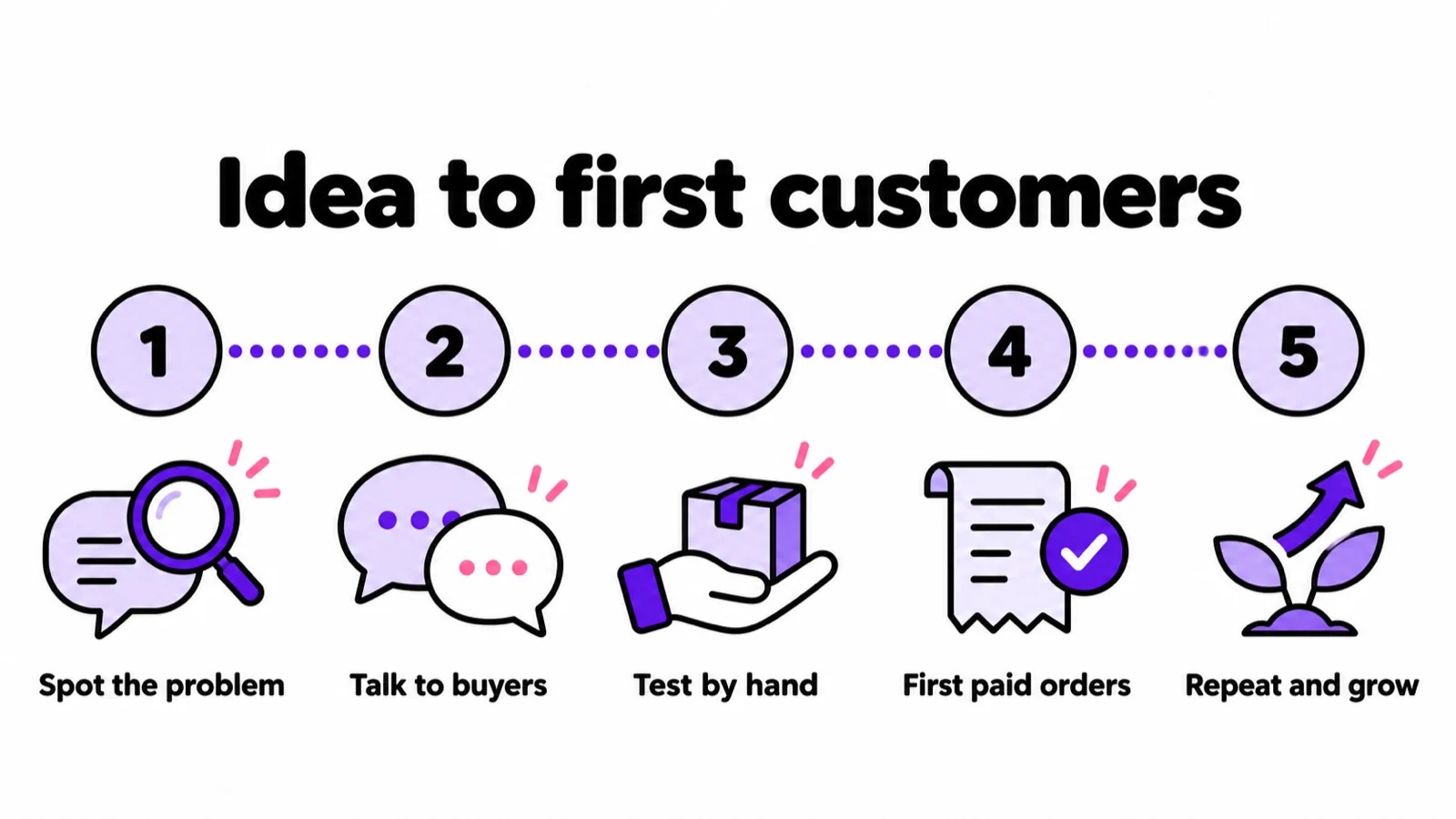
The best-documented early-stage startup example I know is DoorDash in 2013, because the Stanford Daily wrote it up while the company was only months old (Stanford Daily, September 2013). Here is the path from idea to first customers, step by step.
Step 1: Interview before you build
The founders interviewed more than 100 small business owners and kept hearing the same complaint: owners turned down requests to deliver their products.
Step 2: Put a price on the problem
One restaurant owner on University Avenue told them that a delivery from Palo Alto to Mountain View cost about $50 on average. A problem with a price tag is one people will pay to solve.
Step 3: Build the smallest test in an afternoon
PaloAltoDelivery.com took one afternoon to build and received its first online order right away.
Step 4: Deliver by hand
Before joining Y Combinator in summer 2013, the four founders delivered a couple hundred orders to Stanford themselves. Doing the work yourself is the fastest way to learn where the process breaks.
Step 5: Grow what works
Over that summer DoorDash orders grew tenfold and the courier team went from four to 30 people, half of them Stanford students.
Your version: idea to first customers in 6 weeks
| Week | What you do | Proof to collect |
|---|---|---|
| 1 | Pick one problem and write a one-sentence problem statement | 3 versions of the statement, ranked |
| 2 | Interview 20 to 30 people who have the problem | Notes with the exact words they use |
| 3 | Price the problem: what does it cost them today in money or time? | One number per interview |
| 4 | Build the smallest test: a landing page, a form, a pop-up or a demo video | A link people can act on |
| 5 | Deliver by hand to the first buyers | First payments or signed pre-orders |
| 6 | Decide to grow, change or drop the idea | A written decision with the numbers |
For week 1, borrow a format from our startup problem statement examples. For week 4, the free go-to-market strategy generator drafts a launch plan you can edit. And if you want to rehearse the whole loop before you risk real money, our startup game takes players from idea to first customer with the support of AI tools.
FAQ about startup business examples
What is the best example of a startup business?
Airbnb is the example most people cite: it started with three guests in a San Francisco home in 2007 and counted more than 5.5 million hosts by May 2026. For a woman-founded example, Canva grew from a school yearbook business into a design platform valued at $3.2 billion in 2019.
What does startup company mean?
A startup company is a young business designed to grow fast by selling a repeatable product to a large market. A new bakery is a new business; Stripe in 2009 was a startup.
What are 5 examples of startups?
Airbnb (travel), Stripe (payments), Canva (design software), DoorDash (food delivery) and Spanx (apparel). All five won their first customers with hands-on moves before they had big budgets.
What makes a startup successful?
A problem people already pay to solve, first customers won by hand, and enough cash to outlast the slow start. In CB Insights’ 2026 analysis, 70% of failed venture-backed startups ran out of capital and 43% had poor product-market fit.
Is a small business the same as a startup?
No. A small business aims for steady profit in a defined market, while a startup is built for fast growth. A small startup sits in between: tiny team, repeatable product, big ambition.
What is an example of an early-stage startup?
DoorDash in 2013: the founders interviewed more than 100 business owners, built a one-page site in an afternoon and delivered a couple hundred orders themselves before joining Y Combinator.
Which successful startups were founded by women?
Canva (Melanie Perkins), Spanx (Sara Blakely), Bumble (Whitney Wolfe Herd), Glossier (Emily Weiss), Rent the Runway (Jennifer Hyman and Jennifer Fleiss) and Stitch Fix (Katrina Lake) are six well-documented examples.
Where can I find examples of new startups?
Browse the Fe/male Switch company directory for small, young companies, and the Y Combinator company directory for venture-backed ones.
Keep learning
- Problem statement canvas: turn your interview notes into one clear problem
- How to calculate TAM, SAM and SOM for a startup: size the market before you pitch it
- Business model canvas ideas: map how your startup will make money
- Business ideas for women entrepreneurs: more ideas to test with your first customers
- What is the easiest business to start: options for a first venture with low risk
Authors

Mean CEO | Violetta Bonenkamp AUTHOR
MeanCEO (aka Violetta Bonenkamp) is a serial startup founder who brings a decade of entrepreneurial experience to the table. Armed with five Higher Education degrees (including an MBA) and profound knowledge in sectors like blockchain, AI, zero code and education she is a maestro in turning ideas into validated businesses, building prototypes in a few hours and devising marketing strategies for tech startups that increase founder's chances of success. Recognized as one of the top 100 women in EU startups, her guidance is a treasure trove for upcoming and established entrepreneurs alike. Through her venture into entrepreneurship, she has created the "gamepreneurship" methodology, an innovative method for learning business through gameplay.

Elona Musk
Elona Musk stands as a mix of innovation and expertise in the realm of AI, serving as the Chief AI Officer at Fe/male Switch. As an embodiment of the startup game for women, Elona is the co-founder you dream of - knowledgeable, always active, capable of keeping trade secrets to herself and equity-free. With her hands-on approach in entrepreneurship simulation, she provides vital strategies and insights that are essential for navigating the complex startup journey and saves entrepreneurs hours of work by automating many tasks, starting from market research to managing social media to writing business plans. Whether it's a marketing strategy for tech startups that you need or a solid IP strategy, Elona's AI-driven insights help carve successful paths for entrepreneurs who don't have technical or startup skills.
Who we are
We are experienced and fun entrepreneurs and awesome AI PlayPals who love building a startup simulator for you to succeed in business

Violetta Bonenkamp
Business and AI expert

Dirk-Jan Bonenkamp
Legal, IP and finance expert
Elona Musk
The first AI entrepreneur

Petra Thiel
The first AI startup investor

Samantha Altman
The first AI startup mentor

Sia Quick
AI Market Research expert
Unleash your inner founder with AI Startup Tools!
Don't just dream it, build it with our range of AI startup tools. From brainstorming ideas to naming your product and crafting a unique logo, these AI tools are your secret weapon to conquer the startup world.
 Newest
Boost Your SEO Game
Generate a customized SEO strategy for your small business agency by answering a simple question. Our tool focuses on free and easy…
 27
19
5/5
Newest
Positioning Pro - Your Strategic Partner
Positioning Pro helps bootstrapped entrepreneurs discover effective segmentation and targeting strategies without spending money. Get tailored insights simply by answering one question.
13
6
5/5
Newest
Gated Content Strategy Tool
This tool provides actionable strategies for bootstrapped entrepreneurs, leveraging free and easy methods to kickstart your journey.
25
18
5/5
Recommended for you
Pitch Deck Agencies for Climate Tech Startups, Energy and Biotech Founders
Pitch deck agencies for climate tech startups, energy and biotech founders: who handles science-heavy decks, published prices and how to brief them.
Read more
Write for Us: Business, Technology and Startup Guest Posts
Write for us: business, technology, AI and fintech guest posts for founders. See what Fe/male Switch publishes, the guest post checklist and how to pitch.
Read more
7 Catchy and Unique Business Name Ideas
Explore 7 catchy business name ideas that stand out! Get easy tips, hacks, and a splash of humor to kickstart your startup journey! Dive in and find your…
Read more