Youth Business Ideas for Young Entrepreneurs (Teens to 25)
TL;DR
The best youth business ideas start with a skill you already have and almost no money: pet care, tutoring and tech help at 13 to 15, freelance and online work through a parent-held account at 16 to 18, and businesses you register yourself from 18. Pick one, land three paying customers before you spend anything, and see our business ideas for students if you're already at college.
 Mean CEO | Violetta Bonenkamp
14/09/2024 - 20 mins read
Join the F/MS Startup Game now
Access all AI tools, advanced features & more!

Harness our free AI tools for building your startup.

Get a customized live roadmap for your startup.

Join our Community and connect with entrepreneurs.
The best youth business ideas are small service businesses you can start this month with skills you already have: pet sitting, tutoring younger kids, tech help for neighbors and handmade goods at 13 to 15, freelance and online work from 16, and businesses you register and sign for yourself once you’re legally an adult. Your age matters as much as your idea, because it decides what you can sign, which platforms let you sell and how involved your parent or guardian has to be.
Most lists of business ideas for young people skip that second part, and it’s exactly where teens get stuck: a payment account that needs an adult, a client who wants a signed contract, a tax rule nobody mentioned. This guide sorts ideas by age band with rough costs, skills and a parent or legal note for each, then covers online and no-money ideas, starting at 16, seven young founders who started early and six youth programs and competitions running in 2026. I’m Violetta Bonenkamp, also known as Mean CEO, founder of Fe/male Switch, a startup game for women founders, and I’d rather see you start small and real than big and imaginary.
What are good business ideas for youth?
Good business ideas for youth cost little to start, use a skill you already have, fit around school and are legal at your age without paperwork only an adult can sign. Service businesses pass all four tests, which is why I tell young founders to sell their time first and products later.
The 5-question test for any youth business idea
- Can you deliver it next weekend? If it needs months of building, save it for later and pick a faster first business.
- Do you know 10 people who could pay for it? Neighbors, your parents’ friends, local shops, sports clubs and teachers all count.
- Does it cost less than $50 to start? Your first business is a paid course in selling, so keep the tuition low.
- Is it safe and legal at your age? Power tools, driving, food sales and signed contracts all need an adult check first.
- Will you still enjoy it in month three? Pick work you can repeat 30 times without dreading it.
Here is my favorite shortcut: write down what the adults around you complain about every week. Dog walks nobody has time for, a new phone grandma can’t set up, a local shop whose Instagram went quiet months ago, a kid who needs help with fractions. Each complaint is a possible customer, and you already know where they live.
If you’re already at college or university, our hub of business ideas for students sorts ideas by hours per week and campus fit. And if you’re staring at a blank page, our free business idea generator turns your skills and interests into a first shortlist.
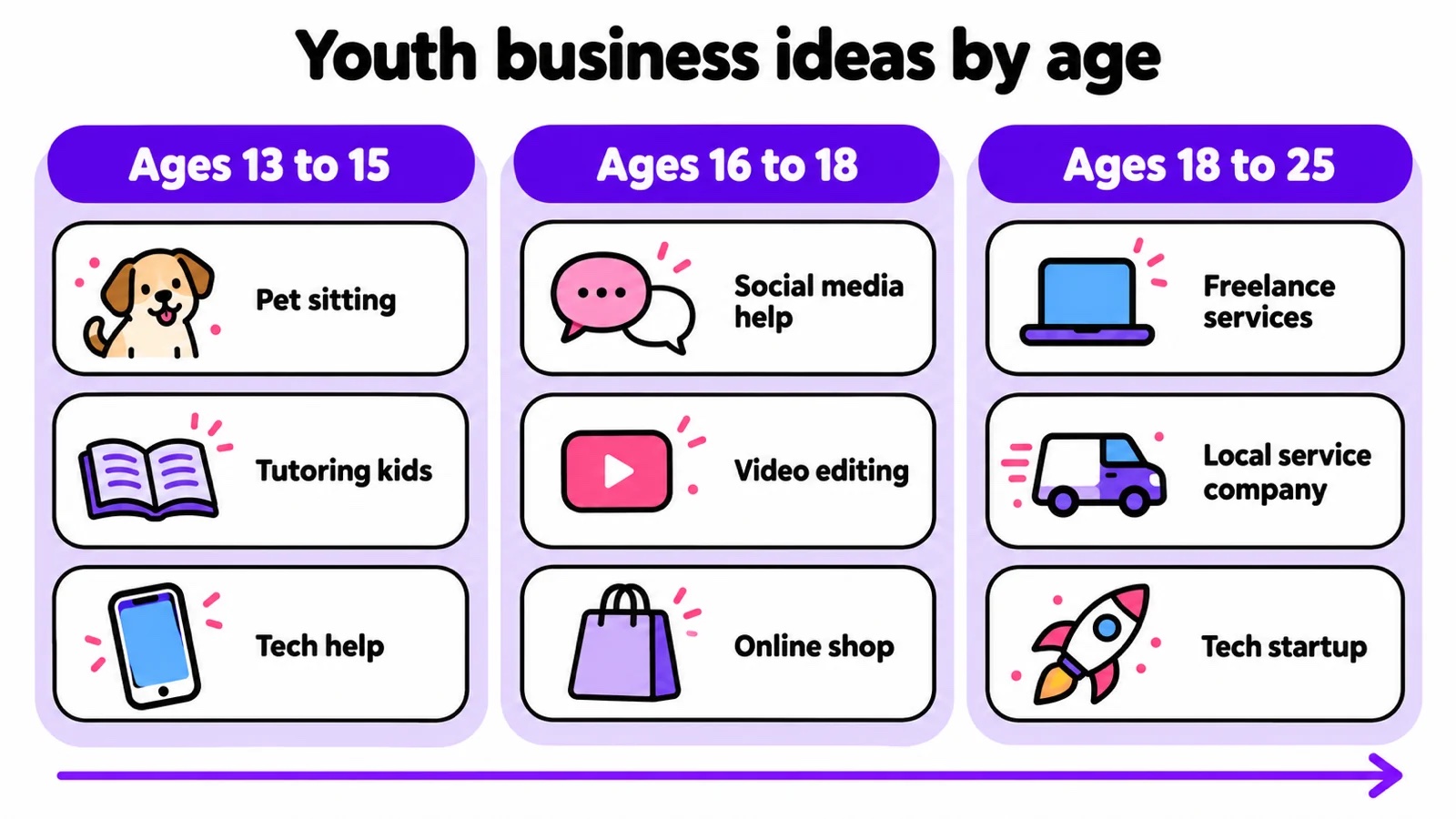
Business ideas by age: 13 to 15, 16 to 18 and 18 to 25
At 13 to 15, stick to neighborhood services a parent can oversee. At 16 to 18, add freelance and online work through a parent-held account, and once you’re legally an adult (18 in most of the places covered here) you can sign, register and sell on the big platforms yourself. The table shows rough starting costs (my estimates of what you need to buy, as of October 2026), the skills each idea needs and the parent or legal note to check first.
| Age | Business idea | Rough starting cost | Skills you need | Parent or legal note |
|---|---|---|---|---|
| 13 to 15 | Pet sitting and dog walking | $0 | Reliability, comfort with animals | A parent knows every address and schedule; start with neighbors you know. |
| 13 to 15 | Babysitting or mother’s helper | $0 (optional course: $45) | Patience, first aid | The Red Cross Babysitting Basics online course is designed for ages 11 and up; agree on hours with your own parents too. |
| 13 to 15 | Tutoring younger kids or music lessons | $0 | A subject or instrument you’re strong in | Sessions at the family’s home, or online with an adult nearby. |
| 13 to 15 | Tech help for older neighbors | $0 | Phones, video calls, patience | Work in shared rooms and never write down anyone’s passwords. |
| 13 to 15 | Baked goods or handmade items at school fairs | $20 to $100 | Baking or making, pricing | Food sales follow local health rules; ask the school or market organizer before you sell. |
| 16 to 18 | Social media help for local shops | $0 | Writing posts, short video, consistency | The shop keeps ownership of its accounts; a parent co-signs if the shop wants a written agreement. |
| 16 to 18 | Video editing or thumbnail design for creators | $0 to $100 | Editing apps, a good eye | Fiverr requires account owners to be 18; ages 13 to 17 can only sell through a parent-owned account. |
| 16 to 18 | Etsy shop with handmade or digital products | $20 to $100 | Design, product photos | Etsy allows ages 13 to 17 only through a parent’s account, with the parent’s billing details and email. |
| 16 to 18 | Reselling thrifted clothes, books or gear | $50 to $200 | Spotting value, photos, pricing | Check the resale app’s age rule before you list, and keep every receipt for tax. |
| 16 to 18 | Roblox game development | $0 | Coding in Luau, game design | Roblox lets developers cash out through DevEx from age 13, with a 30,000 earned Robux minimum. |
| 18 to 25 | Freelance design, writing, web or code | $0 to $300 | One skill clients pay for | You sign contracts and invoices yourself; register with your tax office when your country requires it. |
| 18 to 25 | Online store or print on demand | $50 to $300 | Product choice, marketing | Shopify account owners must be 18 or the local age of majority, whichever is older. |
| 18 to 25 | Local service company: cleaning, moving help, a tutoring agency | $50 to $300 | Managing people and schedules | Insurance and employment rules apply once you hire helpers. |
| 18 to 25 | YouTube or content business | $0 to $300 | On-camera skills, editing | AdSense for YouTube requires age 18; younger creators link a parent’s approved account. |
| 18 to 25 | Tech startup or app | $0 to $500 | Coding, or a technical co-founder | Programs like the Thiel Fellowship (age 22 or younger) fund full-time builders. |
Ages 13 to 15: sell to people you already know
Your first customers live within walking distance. Ask your parents to mention your service to five friends, offer one free trial in exchange for an honest review, and log every job, the hours and the money in a notebook. That notebook becomes your first business record.
If babysitting is your thing, a certificate helps parents say yes. The American Red Cross Babysitting Basics online course is designed for ages 11 and up, takes about 4 hours, includes a section on starting a babysitting business and costs $45 as of October 2026.
Ages 16 to 18: real freelance work, with a parent on the account
At 16 you can do work adults pay real money for, like editing videos, running a café’s posts or building a simple website. The catch is paperwork: Etsy, Fiverr and Shopify all want an adult as the account owner (details in the online section below). Treat your parent or guardian as your first business partner. They hold the account, you do the work, and a simple written split of the money keeps everyone calm.
School can help here too. If your class assigns a business project, turn your real side business into the project. Our list of entrepreneurship project ideas shows how to frame it for a teacher.
Ages 18 to 25: register, price properly and think bigger
Once you’re legally an adult, you sign your own contracts, open your own business bank account and sell on the big platforms yourself. Use these years to test an idea with room to grow, before rent and a full-time job eat your free hours. If you’re in college, our guide to startup business ideas for college students goes further into ideas that can outgrow a side income.
Online business ideas for young people
The best online business ideas for young people are services you can deliver through a screen: video editing, social media help for local businesses, design, online tutoring and coding. Products like Etsy listings, Roblox games and YouTube channels work too, but each platform sets its own age rule, so check it BEFORE you build.
| Online idea | Where it runs | Age rule to check (as of October 2026) | First step |
|---|---|---|---|
| Handmade or digital products | Etsy | 18+; ages 13 to 17 only through an account owned by a parent or guardian (Etsy Help) | List 5 products with photos taken in daylight. |
| Freelance gigs: editing, design, voiceover, writing | Fiverr | 18+; ages 13 to 17 only through a parent-owned account (Fiverr minors policy) | Make 3 sample pieces before your first gig. |
| YouTube channel | YouTube with AdSense | AdSense for YouTube needs age 18; under 18, link a parent’s approved account (Google AdSense Help) | Publish on a fixed schedule for 3 months before you judge results. |
| Roblox games | Roblox Developer Exchange (DevEx) | 13+, 30,000 earned Robux, a verified email and a tax form on file (Roblox Creator Hub) | Ship a tiny game first, then improve it every week. |
| Your own online store | Shopify | Account owner must be 18 or the local age of majority, whichever is older (Shopify Terms of Service) | Test demand on a marketplace before paying for a store. |
| Social media help for local businesses | The client’s own accounts | The business owns the accounts and gives you access | Offer one local shop a 2-week trial. |
| Online tutoring | Video calls | Under 18, a parent arranges sessions and payments | Start with younger kids of family friends. |
Which online idea earns money fastest?
Services earn faster than content. A café can pay you for 12 posts this month, while a YouTube channel needs an audience before it pays anything. My order for teens who want online income: start with one service for local businesses, use the money to buy better tools, and build a content channel on the side as the long game.
Online also means your buyers can live anywhere. Once you sell beyond your town, our guide to international business ideas covers what changes when your customers are abroad.
Business ideas for young entrepreneurs with no money
With no money, sell your time and skills using tools you or your customer already own: pet care, tutoring, yard and snow work, errands, cleaning, tech help, social media help and video editing on your phone. A budget of $0 (or 0 rupees) is enough for every idea below.
| No-money idea | What you already have | How to get the first customer |
|---|---|---|
| Dog walking and pet sitting | Your feet and a phone | Ask 5 neighbors with dogs; offer the first walk free. |
| Tutoring | A subject you’re good at | Tell your former teachers you’re available for younger students. |
| Yard work and snow shoveling | The customer’s tools | Knock on doors the morning after the first snow. |
| Errands and grocery runs for older neighbors | A bike or a bus pass | Ask at your grandparents’ building or a community center. |
| House and car cleaning | The customer’s supplies | Start with relatives and ask each one for 2 referrals. |
| Tech help | A phone and patience | Pin a note on a community board: “Your new phone set up in 30 minutes.” |
| Social media help | A phone | Offer a shop 3 free posts, then a monthly price. |
| Video editing | Free editing apps on your phone | Edit one free sample for a local creator, band or sports club. |
My first-$100 rule
Spend nothing until customers have paid you $100, and skip the logo, website and business cards for now. Word of mouth brings a teen business its next customer, so put your energy into doing great work for the first five. Once you cross $100, reinvest in the ONE thing that lets you take more jobs, like a leash set for walking three dogs at once or a ring light for editing and filming gigs.
When you’re ready to spend a little, our list of low cost businesses to start shows ideas with real startup costs.
How do you become an entrepreneur at 16?
To become an entrepreneur at 16, pick a service you can deliver legally and safely, get your parent or guardian on board for accounts and contracts, check your country’s tax and registration rules, and land three paying customers before you spend money. Rules differ by country, and in some countries by state or province, so use this as general guidance and read the official pages linked below for where you live.
6 steps to start a business at 16
- Pick a business you can run legally at 16. Services that need no license, car or heavy machinery are the simplest start.
- Bring your parent or guardian in early. In the Netherlands, parents can reverse contracts a minor signed without their permission up to 3 years back (Business.gov.nl), and platforms like Etsy and Shopify want an adult on the account. Your parent is your co-signer, so make them an ally from day one.
- Check registration and tax rules. The country table below shows four examples.
- Keep business money separate. Ask your bank about a youth or joint account so client payments don’t mix with birthday money.
- Keep records from the first job. The IRS advises young entrepreneurs to make and keep financial records and receipts during the year (IRS Tax Tip). The habit pays off in every country.
- Protect school time. Set fixed business hours, like two evenings and Saturday morning, and say no outside them.
What the rules look like in four countries
| Country | What to know at 16 (as of October 2026) | Official source |
|---|---|---|
| United States | Everyone, including minors, must file a tax return with net self-employment earnings of at least $400. Registration and licenses depend on your state and city. | IRS |
| United Kingdom | The trading allowance covers up to £1,000 a year of trading income, including casual services like babysitting or gardening. With gross trading income over £1,000, you must tell HMRC. | GOV.UK |
| Netherlands | There’s no minimum age to start a business, but you need your parents’ or guardian’s permission to register with the KVK (Chamber of Commerce). At 16 or 17 you can ask the district court for limited legal capacity (handlichting), which lets you act as an adult for the business matters the court approves, such as a business bank account and contracts. Court fees are about €100. School is compulsory up to and including the school year in which you turn 16. | Business.gov.nl, KVK |
| Canada (Ontario) | The Summer Company program funds student businesses for ages 15 to 29; if you’re under 18, a parent or guardian signs the agreement. | Ontario.ca |
Outside these four countries, search your government’s business portal for “starting a business as a minor” and trust the official government page over forum threads. This section is general information; a local accountant or your country’s business help line can confirm the details for your situation.
Young entrepreneurs who started early
These seven founders started as kids, teens or students, and all of them began with something small and close to home: a lemonade recipe, a jar of jam, bow ties sewn with a grandmother, a student magazine. Each row links to the source I checked.
| Founder | When they started | First business | What happened next | Source |
|---|---|---|---|---|
| Mikaila Ulmer | After two bee stings at age 4; business started in 2009 | Lemonade sweetened with honey, from her great-grandmother’s 1940 recipe (now Me & the Bees) | $60,000 on Shark Tank, then a 2016 deal for 55 Whole Foods stores | NBC News |
| Alina Morse | About age 7, after a bank trip with her dad | Zollipops sugar-free lollipops, funded with $7,500 of savings from her grandparents | Sales passed $70,000 in 2014 and reached $300,000 in 2015 | Smithsonian Magazine |
| Moziah Bridges | Age 9 | Mo’s Bows, bow ties he started making with his grandmother | An NBA licensing deal in 2017, at 15 | Sports Illustrated Kids |
| Fraser Doherty | Age 14 | SuperJam, built on his gran’s jam recipes | Supplied Waitrose from 2007 as the youngest stockist to a major supermarket; appointed MBE in 2014 | Startups.co.uk |
| Richard Branson | Age 16 | Student magazine, launched in 1968 after he left school to start it | His first business, years before Virgin | Virgin.com |
| Melanie Perkins | University student in Perth; left university at 19 | Fusion Books, an online yearbook design tool she co-founded with Cliff Obrecht in 2007 | Canva launched publicly in 2013 | Wikipedia |
| Michael Dell | Age 19 | PC’s Limited, started with $1,000 in 1984, selling PC upgrade kits from his University of Texas dorm room | The company that became Dell | Academy of Achievement |
What these young founders have in common
- A problem they felt themselves. Bee stings, a missing bow tie, design software that was slow to learn (Perkins tutored graphic design students before Fusion Books).
- Family as first investor or supplier. Grandparents’ savings for Morse, a grandmother at the sewing table for Bridges, a gran’s recipes for Doherty and a great-grandmother’s recipe for Ulmer.
- A small first version. Upgrade kits came before Dell’s computers, and school yearbooks came before Canva.
- Adults who opened doors. A Shark Tank investor backed Ulmer, Waitrose stocked Doherty’s jam and the NBA licensed Bridges’ bow ties.
My takeaway: start with something a neighbor can buy this month, and let the bigger idea grow out of what customers tell you.
Youth entrepreneurship programs and competitions
Six youth entrepreneurship programs and competitions worth knowing in 2026 are the JA Company Program, NFTE’s World Series of Innovation, the Diamond Challenge, Ontario’s Summer Company, The King’s Trust Enterprise programme and the Thiel Fellowship. They range from school mini-companies at 15 to $250,000 for builders aged 22 or younger. The details below are as of October 2026, so check each site for current deadlines.
| Program | Who can join | What you get | Timing |
|---|---|---|---|
| JA Company Program | High school students; JA Europe lists ages 15 to 18 | Run a real mini-company: elect a board, sell shares, make and sell a product, report to shareholders | Runs over a school year through local JA offices |
| NFTE World Series of Innovation | Ages 5 to 24, in two leagues (5 to 12 and 13 to 24) | Challenges tied to the UN Sustainable Development Goals, with prizes for winners | 2026-2027 edition open; entry deadline listed as December 13 |
| Diamond Challenge | High school students aged 14 to 18, in teams of 2 to 4 with an adult advisor aged 21+ | Business and social venture tracks; grand prizes of $12,000, $8,000 and $4,500 in each track | Submit by January 14, 2027; in-person finals April 29 to 30, 2027 |
| Summer Company (Ontario) | Ages 15 to 29, living in Ontario and returning to school | Up to $3,000 (CAD) plus mentoring | Runs over the summer; the 2026 deadline was May 15, 2026 |
| The King’s Trust Enterprise programme | Ages 18 to 30, starting a business in the UK | One-to-one support, mentoring, grants and loans | Join through The King’s Trust |
| Thiel Fellowship | Age 22 or younger, without a university degree | $250,000 over two years | Applications accepted year-round |
JA Company Program (JA Worldwide)
JA Worldwide says it delivers more than 23 million student experiences a year in over 100 countries. Its Company Program is the classic school mini-company: in Europe alone, about 360,000 students aged 15 to 18 run roughly 30,000 mini-companies each year, electing a board, selling shares, selling a real product and competing in “company of the year” competitions (JA Europe). Ask your school or your country’s JA office whether it runs near you.

NFTE World Series of Innovation
NFTE (Network for Teaching Entrepreneurship) has brought entrepreneurship education to young people in underserved communities since 1987, and its homepage announces the 2026-2027 World Series of Innovation for ages 5 to 24. Teams and individuals worldwide answer challenges tied to the UN Sustainable Development Goals, in English, Spanish, Arabic, Simplified Chinese or Hindi (NFTE). Entries go in through the challenge site, which listed a December 13 deadline in October 2026.

Diamond Challenge
The Diamond Challenge is a high school entrepreneurship competition run by Horn Entrepreneurship at the University of Delaware. Teams of 2 to 4 students aged 14 to 18, plus one adult advisor aged 21 or older, pitch a business or social venture. The 2027 round closes on January 14 and ends with in-person finals at the Limitless World Summit on April 29 and 30 (competition rules).

Summer Company (Ontario, Canada)
Ontario’s Summer Company gives students aged 15 to 29 up to $3,000 to run a summer business: up to $1,500 up front for start-up costs and up to $1,500 after completing the program. High school students commit at least 280 hours, and if you’re under 18, a parent or guardian signs the agreement. The 2026 deadline was May 15, 2026, so watch the page for the next round.
The King’s Trust Enterprise programme (UK)
The King’s Trust supports people aged 18 to 30 who want to start a business anywhere in the UK. According to GOV.UK, the Enterprise programme offers one-to-one support and mentoring, a Test My Business grant of up to £500, start-up grants of up to £5,000, loans from £500 to £25,000 and up to 3 years of support after launch. Funding isn’t guaranteed, and you need to own, or plan to own, at least 50% of the business.
Thiel Fellowship
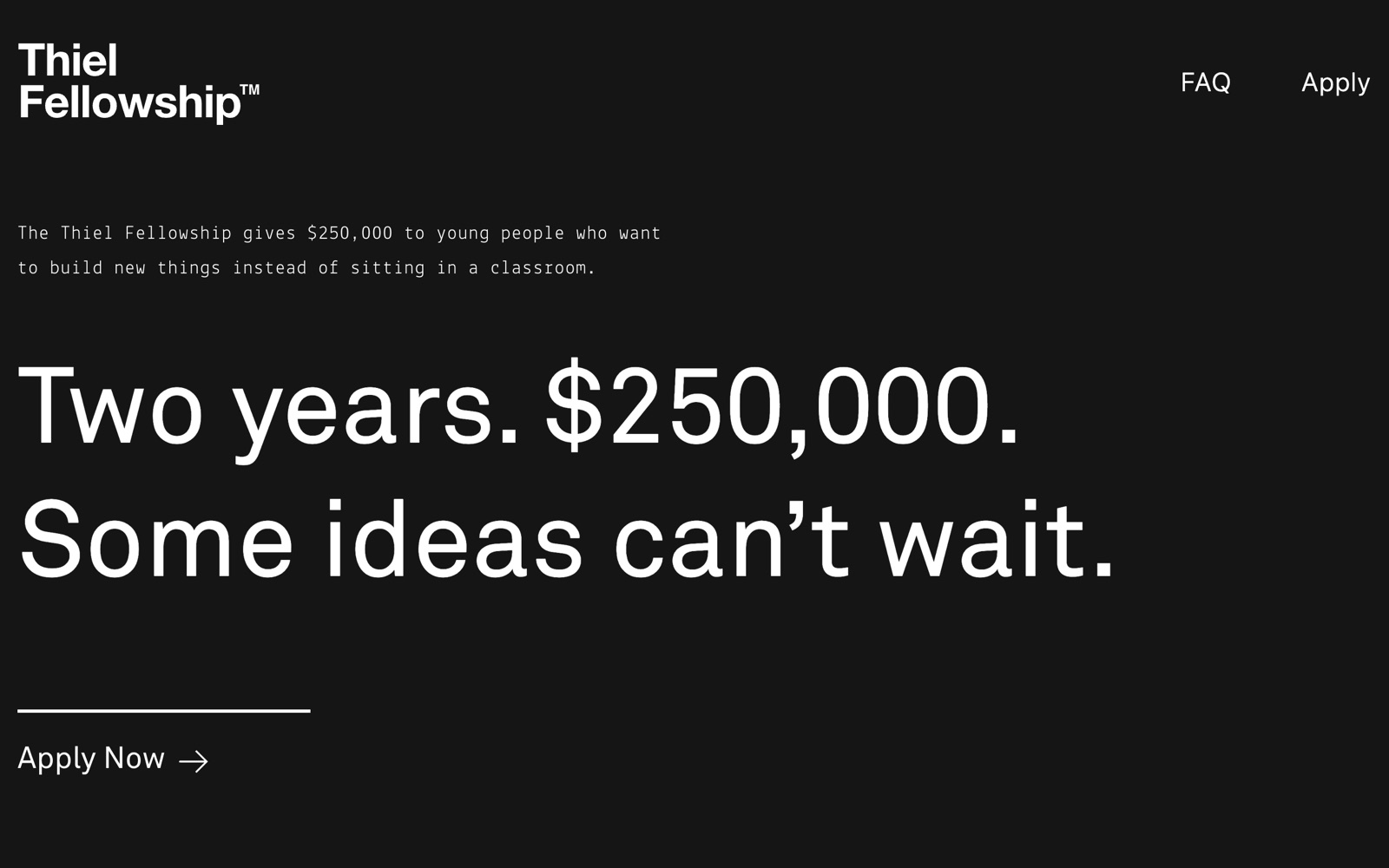
The Thiel Fellowship gives $250,000 over two years to young people who skip or stop out of college to build something. Anyone aged 22 or younger without a university degree can apply, and applications are accepted year-round (Thiel Fellowship FAQ). It’s the big-league option on this list, best for a founder who already has a working project and a reason to go all in.
Practice before you pitch
You’ll pitch better in a competition if you’ve already tested your idea somewhere safe. Our list of business games for students covers classroom and online options for that rehearsal. When you’re ready to build a real startup in a guided setting, the Fe/male Switch startup game, our women-first startup game, walks you from idea to first customer step by step, and Elona Musk, our AI co-founder, keeps nudging you toward the next task.
FAQ about youth business ideas
What is the best business for young entrepreneurs?
The best business for young entrepreneurs is one you can deliver this month with a skill you already have: tutoring, pet care or tech help for teens, and a freelance service like design, editing, writing or code from 18. Add products once customers tell you what they’d buy.
What business can a 12- or 13-year-old start?
At 12 or 13, pick neighborhood services a parent can oversee: pet sitting, helping a family with younger kids, tech help for grandparents or selling baked goods at school events with permission. From 13, Etsy and Fiverr allow selling only through an account owned by a parent or guardian.
What are good at-home business ideas for teens?
Good at-home business ideas for teens include online tutoring with an adult nearby, video editing, design work for local clubs, handmade products sold through a parent’s Etsy account and Roblox games, which can pay out through DevEx from age 13.
Can a 15-year-old start a business?
Yes. In the four countries covered above, a 15-year-old can run a small business, with a parent or guardian handling accounts, contracts and registration. In the Netherlands there’s no minimum age to start a business, and you register with the KVK with your parents’ permission. Check your own government’s business portal for local rules.
Do teenagers pay tax on business income?
It depends on the country and the amount. In the US, the IRS says anyone, including minors, must file a tax return with net self-employment earnings of at least $400. In the UK, the £1,000 trading allowance covers small amounts of trading income. Keep records of every sale and expense either way.
Which business can I start with zero investment?
Dog walking, tutoring, yard and snow work, errands, cleaning with the customer’s supplies, tech help, social media help and phone-based video editing all start at $0, or 0 rupees. You sell time and skill, and the customer or your own phone provides the tools.
Keep learning
- Business startup ideas for students: startup ideas with room to grow past a side income.
- Easy business ideas: simple businesses you can start from home with little money.
- What is the easiest business to start?: how to pick a first business with the fewest hurdles.
- Entrepreneur games: games that train selling, pricing and teamwork.
- Free courses to start a business: free lessons on planning, money and marketing.
Authors

Mean CEO | Violetta Bonenkamp AUTHOR
MeanCEO (aka Violetta Bonenkamp) is a serial startup founder who brings a decade of entrepreneurial experience to the table. Armed with five Higher Education degrees (including an MBA) and profound knowledge in sectors like blockchain, AI, zero code and education she is a maestro in turning ideas into validated businesses, building prototypes in a few hours and devising marketing strategies for tech startups that increase founder's chances of success. Recognized as one of the top 100 women in EU startups, her guidance is a treasure trove for upcoming and established entrepreneurs alike. Through her venture into entrepreneurship, she has created the "gamepreneurship" methodology, an innovative method for learning business through gameplay.

Elona Musk
Elona Musk stands as a mix of innovation and expertise in the realm of AI, serving as the Chief AI Officer at Fe/male Switch. As an embodiment of the startup game for women, Elona is the co-founder you dream of - knowledgeable, always active, capable of keeping trade secrets to herself and equity-free. With her hands-on approach in entrepreneurship simulation, she provides vital strategies and insights that are essential for navigating the complex startup journey and saves entrepreneurs hours of work by automating many tasks, starting from market research to managing social media to writing business plans. Whether it's a marketing strategy for tech startups that you need or a solid IP strategy, Elona's AI-driven insights help carve successful paths for entrepreneurs who don't have technical or startup skills.
Who we are
We are experienced and fun entrepreneurs and awesome AI PlayPals who love building a startup simulator for you to succeed in business

Violetta Bonenkamp
Business and AI expert

Dirk-Jan Bonenkamp
Legal, IP and finance expert
Elona Musk
The first AI entrepreneur

Petra Thiel
The first AI startup investor

Samantha Altman
The first AI startup mentor

Sia Quick
AI Market Research expert
Unleash your inner founder with AI Startup Tools!
Don't just dream it, build it with our range of AI startup tools. From brainstorming ideas to naming your product and crafting a unique logo, these AI tools are your secret weapon to conquer the startup world.
 Newest
Boost Your SEO Game
Generate a customized SEO strategy for your small business agency by answering a simple question. Our tool focuses on free and easy…
 27
19
5/5
Newest
Positioning Pro - Your Strategic Partner
Positioning Pro helps bootstrapped entrepreneurs discover effective segmentation and targeting strategies without spending money. Get tailored insights simply by answering one question.
13
6
5/5
Newest
Gated Content Strategy Tool
This tool provides actionable strategies for bootstrapped entrepreneurs, leveraging free and easy methods to kickstart your journey.
25
18
5/5
Recommended for you

Venmo Small Business Grant: Amounts, Rules and Next Round
Every Venmo Small Business Grant round checked against Venmo's and PayPal's own pages: amounts, winners, eligibility, judging, status and open alternatives.
Read more
Small Business Grants for Women in Texas: Amounts and Dates
Texas grants for women-owned businesses checked on official pages: TWU StartUP and Rural grants, Amber Grant, state and city programs, rules and deadlines.
Read more
Your First Cold Campaign: A Deliverability Guide for Founders
First cold email campaign? Set up a separate sending domain, SPF, DKIM and DMARC, warm up, clean your list and run this pre-send checklist before you hit send.
Read more